Oregon Field Guide
Sage Grouse Face New Threat, Geoduck Diving, Crater Lake’s Forgotten Destination
Season 37 Episode 5 | 29m 29sVideo has Closed Captions
Sage grouse face new threat. The NW’s oddest bivalve. Crater Lake’s forgotten destination.
A proposed lithium mine threatens a unique collaboration to protect one of the West’s most distinctive birds. A young couple in the Puget Sound makes a living harvesting the world’s largest—and most peculiar—bivalves. The story of how one of Crater Lake's most famous attractions fell into obscurity.
Problems playing video? | Closed Captioning Feedback
Problems playing video? | Closed Captioning Feedback
Oregon Field Guide is a local public television program presented by OPB
Oregon Field Guide
Sage Grouse Face New Threat, Geoduck Diving, Crater Lake’s Forgotten Destination
Season 37 Episode 5 | 29m 29sVideo has Closed Captions
A proposed lithium mine threatens a unique collaboration to protect one of the West’s most distinctive birds. A young couple in the Puget Sound makes a living harvesting the world’s largest—and most peculiar—bivalves. The story of how one of Crater Lake's most famous attractions fell into obscurity.
Problems playing video? | Closed Captioning Feedback
How to Watch Oregon Field Guide
Oregon Field Guide is available to stream on pbs.org and the free PBS App, available on iPhone, Apple TV, Android TV, Android smartphones, Amazon Fire TV, Amazon Fire Tablet, Roku, Samsung Smart TV, and Vizio.
Providing Support for PBS.org
Learn Moreabout PBS online sponsorshipMajor support for Oregon Field Guide is provided by... [ ♪♪♪ ] WOMAN: Come on!
There he is, there he is, there he is.
[ exclaims ] Get him out of there, buddy!
Good boy!
[ laughing ] WOMAN: Whoo, high five!
Yeah!
SCOTT: Next, on Oregon Field Guide: We meet one of the Pacific Northwest's strangest creatures, the geoduck.
WOMAN: It's the world's largest bivalve.
They're just little, unique beings.
And we visit Crater Lake's most famous attraction that you've likely never heard of.
MAN: I've travel-- I've been to all 50 states, I've been in over 50 National Park areas.
I've never seen anything like this anywhere.
But first, a new threat faces the greater sage grouse.
[ popping softly ] Ho, ho, ho!
[ cows mooing ] PROFITA: For the last 10 years, ranchers and environmentalists have been working together to help an extraordinary bird.
MAN: In the winter, they make a living solely on eating sagebrush.
They are super specialized.
The goal of this historic conservation agreement is to keep the greater sage grouse off the Endangered Species List.
A species that is listed makes life miserable, honestly.
So far, it's been working all right... They've been able to hold the listing off.
...but there's a new threat.
On the Oregon/Nevada border, mining companies want to drill for lithium, a valuable metal in batteries for electric cars and renewable energy storage.
MAN: There are about 30 known leks that are within a 4-mile area of the lithium exploration site.
Neighboring ranchers have been working to protect this prime sage grouse habitat.
Now that protection could disappear.
If that project goes in, I just don't see how we can coexist.
And big questions loom over how to recover sage grouse across the West.
[ vehicle engine starts, revving ] MAN: Private land takes up a lot of the West.
And a lot of that private land is really important habitat for wildlife species.
A lot of people I talk to, actually, are surprised that a ranch would hire a wildlife biologist full-time.
[ engine shuts off ] There aren't many people who get to do what Jack Hansen does for a living.
The blinds are out here about 200 yards.
So we'll walk out there and get our chairs set up and hope we can see some birds.
He's a full-time wildlife biologist for Roaring Springs Ranch in southeast Oregon.
[ grouse popping ] So we're out here this morning in the Skull Creek Basin.
A couple dozen birds out there right now.
I have an awesome job, one of the greatest in the world.
I just get to monitor the wildlife populations on the ranch.
This time of the year, I go out and count sage grouse every morning to get a good population estimate.
That estimate helps us know what we need to do as far as habitat work for the sage grouse to help improve their numbers.
It's an unusual job that grew out of an unprecedented agreement: to protect the greater sage grouse.
The birds have 11 mating sites, called leks, across 250,000 acres at Roaring Springs Ranch.
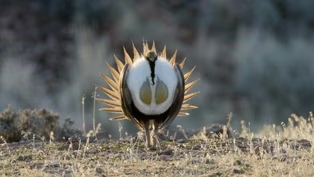
So a lek is pretty much just a congregation spot, a breeding ground where the males go and they basically do a-- they strut for the females, they show off.
They have these air sacs in their chest that they fill up with air.
You can hear that popping sound pretty-- pretty distinctly.
About a decade ago, the rapid decline of these birds across the West threatened to make them the spotted owl of the High Desert.
They were potentially going to get listed on the Endangered Species list because of how poorly the populations were looking around the West.
And so a lot of these landowners, including Roaring Springs Ranch, and the agencies, both state and federal and non-governmental organizations, stepped up and said, "Hey, we gotta do something about this."
[ mooing ] [ indistinct conversation ] MAN: Spring in the high desert.
You go from sunshine to snow to sunshine to snow in a matter of hours.
Ranchers like Stacey Davies did not want to see the sage grouse on the Endangered Species list.
The ranch currently is at about 8,000 mama cows and we run 60 brood mares and four stallions, and so we sell horses, cattle, and hay.
An Endangered Species listing would add new restrictions on where ranchers can graze their cows... and could even put them out of business.
Go right over there and get that-- Did that get it off?
I would much rather focus on money going to healthy environments than regulation, and a species that is listed makes life miserable, honestly.
So he joined more than a thousand ranchers across 11 Western states in the largest landscape-level conservation effort in U.S.
history.
And so you voluntarily agree to conservation measures that you will do to bring a species back to a healthy population.
Those measures required the ranch to monitor the sage grouse and improve the birds' habitat.
To make sure that work was done right, the ranch hired a professional.
HANSEN: Sage grouse, they're low-flying birds, and often the problem is they will collide with barb-wire fences.
Oftentimes, it'll kill 'em.
These reflectors, they'll reflect light and help those birds to see and be able to avoid those wires.
Part of Hansen's job is to help the ranch coexist with sage grouse.
Cattle, they have an impact on sage grouse habitat.
But the ranch has taken a lot of measures over the years to mitigate those impacts as much as possible.
So this is a guzzler.
Roaring Springs has installed a handful of these on the ranch to benefit not just sage grouse but other wildlife species.
We have it fenced off to keep cows out, and the idea is this tin collects rainwater, funnels it into this gutter, and then it, in turn, is funneled into this system here.
We put trail cameras on them.
We had a whole variety of things from chukars and coyotes, deer, antelope, bobcats.
Sage grouse primarily eat sagebrush.
That's mostly what they use for cover, for food.
The ranch is working to protect sage grouse habitat by reducing the biggest threats.
They remove invasive cheatgrass that's known for fueling wildfires.
And they've cut down some of these juniper trees that compete with native grasses.
Juniper trees are a native species as well, but they use a lot of water.
So they'll use a lot of resources that sage grouse need to survive.
All of this work appears to be paying off for sage grouse on the ranch.
The last few years, we have seen an increase.
We've seen 13% increase two years ago and then another 4% increase last year, and this year's looking really good, looking really encouraging.
And the cows are doing well too.
As we manage for ecosystem health, things that were good for fish are good for sage grouse, good for mule deer, but they're also good for the economics of the ranch.
It's a win-win to us.
People like Skyler Vold are tracking just how well this voluntary effort is working.
Surveys like this help to count sage grouse populations across the wide expanse of sagebrush in southeast Oregon.
We're out here in Frenchglen right now.
What we're doing here is searching for leks that we don't currently know about.
We've been out here for three days now and we've found three potential new leks so far.
He helped document a jump in Oregon's sage grouse population in 2024 and 2025, but the population is still down 33% from what it was historically.
[ birds chirping ] [ air sac popping ] Historically, sage grouse lived on this vast area of sagebrush, the sagebrush sea, and that's really what they like.
They need giant landscapes.
Anything that breaks up that habitat can threaten the birds' survival, whether that's wildfire, renewable energy development, or mining operations.
We're pretty concerned about that down in the McDermitt Caldera.
Australia-based mining company Jindalee Resources has proposed exploratory drilling for lithium in the McDermitt Caldera near the Oregon/Nevada state line.
There are about 30 known leks that are within a 4-mile area of the lithium exploration site.
There is really no development, and it's just a really intact sagebrush sea.
And if a giant open-pit mine were to go in here, it would not be good for these populations of sage grouse, let alone any other species in the caldera.
[ cows mooing ] We're going to start these things up the hill.
Hey!
Ho, ho, ho!
If somebody five years ago would've come to me and said, "I'll bet you a million dollars they open a lithium mine in the caldera," I'd have bet my ranch they wouldn't because of the stuff that I've been through with the fish and the sage grouse.
Over the past 30 years, rancher Nick Wilkinson has rearranged his entire ranching operation to protect threatened Lahontan cutthroat trout and declining sage grouse.
Keeping the cows from damaging their habitat meant cutting his herd in half and leasing more grazing land.
I decided that we could not coexist with the fish and the sage grouse if we didn't figure out how to leave lots of feed, lots of cover for the sage grouse-- forbs, shrubs on the stream bank.
More expense, more equipment, more hired help.
It's very micromanaged to make it work.
I've done my due diligence.
I've learned a lot about the fish and I've learned a lot about the sage grouse.
It's been good for the cow man in me to learn more about how it all works.
The mining company wants to build 34 miles of roads and drill hundreds of holes on the federal grazing lands Nick leases from the Bureau of Land Management.
If that project goes in, I just don't see how we can coexist.
This is the only place we can turn these cattle loose this time of year.
That mining claim is one of many surrounding Nick's ranch, and he says this could be the end of his family business.
So this is all claimed, and it's either uranium or lithium.
I realize we need clean energy.
I'm not going to argue, and I'm not going to argue that it's not multiple use.
It is.
It's government ground.
It belongs to the public.
But I want there to be some mitigation.
If you want to take away my operation and my grazing, then buy my ranch.
A full-scale lithium mine would require a lot more permitting.
Supporters say it would be good for the economy and the fight against climate change.
Jindalee says its project won't put any ranches out of business, but Nick still sees a threat, both to his ranch and the sage grouse he's been trying to help.
We've been protecting that caldera.
We're just going to destroy it?
If you let this happen, don't you dare ever open your mouth about listing that bird.
It's not just this caldera.
A surge in mining and drilling proposals across the West is putting more and more habitat at risk.
That could upset the delicate balance these ranchers worked so hard to strike with their sage grouse neighbors.
[ ♪♪♪ ] We got enough fuel?
Yep.
I think if you're in the water by 10:15, you should have a really good day.
You gonna grab this for me?
I'll get the midship.
This is a typical Puget Sound day, you know.
Typical Washington day: gray and rainy.
MAN: Most of our work days look like this.
WOMAN: Yeah.
And you can see, we're in, like, foulies.
We're in our bibs and our gloves and our hoodies, face masks and stuff.
And, like, it's still bitter cold.
MAN: This place is kind of the mecca for farmed shellfish, especially geoduck.
Kind of in the heart of it.
WOMAN: Not a lot of people know about geoducks, even, like, where we live.
Geoduck is a clam native to the Puget Sound.
I work on farms harvesting them.
SNYDER: We go all around the Puget Sound.
We harvest some farms in Totten Inlet, Hammersley Inlet are some of the places we've harvested geoduck.
A lot of wild ones grow, but they're also farmed too.
People are usually very fascinated just by the sound of the job, even though it's not very glamorous at all.
[ both laughing ] Yeah, it's never just like, "I'm a geoduck diver."
It's like, "Do you know what geoduck are?
Do you--?"
It's always like a... Do they even understand what they're about to hear?
We're obviously a small operation.
SNYDER: Honestly, we're a miniature operation... LANDIS: We're tiny tiny.
...in the world of shellfish.
[ engine rumbling ] LANDIS: We're goofy too in our, like, old boat.
SNYDER: And that's how we like it.
We're kind of crusty, but we try to do a good job.
Exactly.
Exactly.
[ both laughing ] Okay, I'm putting the dive flag up.
I think we're kind of unique too in the geoducking world because we're, like, a couple who does it.
And we have been together for like ten years now.
We've been together since high school, so it's pretty awesome to be able to, you know, work together also.
[ Landis breathing echoes over speaker ] LANDIS: Comm check.
Comm check.
LANDIS: Loud and clear.
Ditto.
I kind of have to constantly see where he's at, because the patch is actually pretty small.
You can see the buoys.
There's one yellow buoy right there, one right there, and it's like 200 feet at most, so it's easy to kind of get off of it.
After we get all set up and Ocean gets in the water, we bring up the geoduck bags probably once every hour or so.
So I have a lot of in-between time.
And, yeah, I basically listen to Ocean breathe for like four hours straight.
[ breathing echoing over speaker ] All right, Occy, what are you doing down there?
LANDIS: Right now, I'm just moving along the patch and trying to find geoducks shells.
It's basically just a dimple in the sand that's showing me where the geoduck is.
So I have pressurized saltwater coming out of what I call a stinger.
It's kind of like a big water gun.
Basically once I see the shell, I'm grabbing the tip of the geoduck, making sure not to tug on it, and I dig very deep very fast.
SNYDER: It's the world's largest bivalve.
LANDIS: They're goofy.
SNYDER: Yeah, they are.
LANDIS: They're funny.
SNYDER: It's like nature's joke.
They really are.
LANDIS: Yeah, I still get a chuckle out of them all the time.
You know, even digging hundreds of them a day.
SNYDER: They're just little, unique beings.
The word "geoduck" comes from a local Indigenous language called the Lushootseed language, and it means "dig deep."
The word "geoduck" means "dig deep," which is, like, pretty true to geoducks.
They have, like, a little digger fin on the bottom and they dig really fast.
LANDIS: It's really interesting how long they can live.
It's like 150 years or something.
I was actually kind of, like, afraid of the water as a kid.
Not being on the water, but, like, swimming in the water.
It was uncomfortable and scary.
It was definitely something I never thought I was going to do.
And after months and months of being terrible at it and being freaked out and just kind of fumbling around down there, I started to grow to kind of love it.
You get to spend your day with crabs and fish and... just kind of hanging out in your own cloud down there.
It's always labor-intensive and it's also kind of intense mentally sometimes because you feel the pressure of, you know, you have to get a certain amount of pounds to make it worth it for everybody.
Each geoduck is worth, you know, for me, it's like a buck-fifty or something.
You know, you're down there wearing 70 pounds of weight, hauling around 200 pounds of geoduck.
You know, you're huffing and puffing and... SNYDER: You've been in for 45 minutes on this bag.
LANDIS: Okay, copy that.
SNYDER: Davit's down whenever.
LANDIS: So, you know, to fill up a bag and send up a bag feels pretty good.
Okay, bag's coming up.
And they kind of crack about like an egg, so you have to be really careful because their shells are really fragile.
The market for them is mostly overseas, so a huge percentage of our geoduck goes to China, where it is definitely a delicacy.
It's much more expensive over there.
But there isn't, like, as much of a market for them in our area.
You still can buy them and they're still expensive.
They're still like $25 a pound where we are, but that's much different to, like, in China, where they're going for like hundreds of dollars a pound.
They're actually a totally, like, a wonderful little thing to eat.
It's funny, if you take a geoduck and you're like, "We're going to eat this," people would be like, "Uh, no, we're not."
[ Snyder laughs ] SNYDER: Even me for a while.
LANDIS: But if you cut it, tenderize it, throw it in some breadcrumbs and fry it and then give it 'em, they're, like, fine with it.
Like a lot of things, you know?
Yeah.
Yeah.
You know, it's really, I think... Like, you're not just cooking the geoduck and just holding it and eating the siphon.
[ both laugh ] SNYDER: They actually have a really delicate meat.
They don't have, like, this crazy flavor or anything.
They're really mild, just sort of like-- just like a clam, you know?
It's really reminiscent to a razor clam.
Yeah, they're great.
You just take off the outer sheath and you can just, you know, pound 'em into some fritters or you can chop them up really fine into some ceviche, into chowder, just like you would any other clam.
[ both crunching ] Mm!
BOTH: So good.
[ both chuckle ] [ ♪♪♪ ] LANDIS: Getting out of the water after a long dive, like, you're hungry, you're tired.
When you do that every day for hours, wearing all that weight, pulling these geoduck out, taking these 200-pound bags to the brailer, just getting right back at it... it's a lot of work.
You are tired at the end of the day, and you do know that you can't do it your whole life.
You dig and you get out of the water and you look at all the crates filled with geoduck and you feel pretty good.
Good.
LANDIS: Something about being on the water, just there's a lot of freedom associated with it.
This is the only job I've ever had that I can say I love.
It doesn't keep you longing for some other job or some other lifestyle.
You know, you're doing what you like to do where you like to do it.
[ ♪♪♪ ] GILFILLAN: Down this secluded forest trail, there's a mysterious natural wonder found nowhere else in the world.
It's known as the Pinnacles.
MAN: The Pinnacles are so spectacular, and even though I've seen them hundreds of times, I kind of get goose bumps looking at them.
Jacksonville resident Larry Smith, along with his twin brother, Lloyd, served as Rangers here at Crater Lake National Park for decades.
But that familiarity has never dampened his enthusiasm.
I've travel-- I've been to all 50 states, I've been in over 50 National Park areas, I've never seen anything like this anywhere.
But it's not just the strange beauty of these volcanic spires.
What's so amazing is they've been standing there for 5,000 years, and some of those pinnacles are so delicate, you feel like you can just put your hand around them.
These things are one-of-a-kind, but they've been kind of lost in the overshadowing of the caldera.
By the caldera, Larry means, of course, Crater Lake.
The site was designated Oregon's first and only National Park in 1902.
And the breathtaking 2,000-foot-deep blue lake immediately became a major tourist draw.
[ ♪♪♪ ] But before they reached the spectacle waiting at the rim, tourists traveling from the east were treated to these mysterious pinnacles.
This is the old east entrance to Crater Lake National Park.
The railroad was just outside the area, so people would pick up the stagecoaches, come up this road, and find this beautiful stand of pinnacles.
And they'd stand there and of course ooh and ahh, because where else in the world could you see something like this?
[ ♪♪♪ ] Postcards of the curious features enhanced the lake's alluring promise of singular adventure.
The park's dramatic scenery is all traced back to a mighty mountain the Native people called Giiwas.
It was a very broad mountain, and it went on up gently up to 12,000 feet in elevation.
There were gigantic glaciers on the sides of the mountain.
About 7,700 years ago, the mountain, later renamed Mount Mazama by early park advocate William Steel, erupted.
Superheated flows of ash, gas, and lava rock raced down the sides and into the ice-filled valleys.
Think hot toothpaste, and it came pouring out down through the valley that had been formed by the glaciers and it filled it in 300 feet deep.
Then, because the glaciers had been melted, steam pockets formed down on the bottom of the canyon.
And, of course, steam rises.
As the steam pushed upward through the thick layer of pumice and other volcanic debris, it formed chimneys, or fumaroles.
And the steam, being super hot, welded the pumice together into something that's harder and formed these fumaroles.
Over time, the lighter debris washed downstream, revealing the harder rock of the fossilized fumaroles.
And what we have left behind are these tall spires sticking up here almost 300 feet high.
For decades, the Pinnacles gave tourists a tantalizing preview of the marvels that awaited at the crater's rim.
And then they fell into obscurity.
By 1920, there were roads in the park, and there was a road around the rim.
And by that time, this road was more or less abandoned.
So coming down here is going into a really remote part of the park.
Though mostly forgotten by the more than half a million tourists who visit the park each year, the story of the Pinnacles is still unfolding.
What's so unique here is the erosion is continuing.
Wheeler Creek is moving in underneath where we're standing right now, and as you can see, it's being undercut and those pinnacles are going to fall in.
As the creek moves this way, it's going to continue carving, and there are probably more fumaroles right under where we're standing.
So next time you're at Crater Lake, escape the crowds and find your way to this hidden gem.
You can now find many Oregon Field Guide stories and episodes online.
And to be part of the conversation about nature and the outdoors here in the Northwest, join us on Facebook.
[ birds chirping ] Major support for Oregon Field Guide is provided by... Additional support provided by... and the following... and contributing members of OPB and viewers like you.
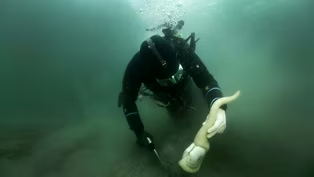
Diving for Geoduck, the World’s Largest Clam
Video has Closed Captions
Clip: S37 Ep5 | 9m 50s | A young couple in the Puget Sound makes a living harvesting the world’s largest clam. (9m 50s)
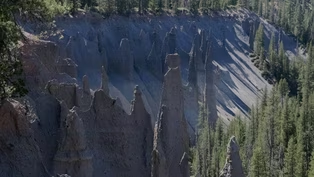
The Lost Pinnacles of Crater Lake
Video has Closed Captions
Clip: S37 Ep5 | 4m 45s | The story of how one of Crater Lake’s most famous attractions fell into obscurity. (4m 45s)
Video has Closed Captions
Clip: S37 Ep5 | 12m 29s | Lithium mining threatens a unique collaboration that’s protected sage grouse for a decade. (12m 29s)
Providing Support for PBS.org
Learn Moreabout PBS online sponsorship















Support for PBS provided by:
Oregon Field Guide is a local public television program presented by OPB