Oregon Field Guide
The Lost Pinnacles of Crater Lake
Clip: Season 37 Episode 5 | 4m 45sVideo has Closed Captions
The story of how one of Crater Lake’s most famous attractions fell into obscurity.
The stunning “pinnacles” of Crater Lake are a unique artifact of ancient Mount Mazama’s cataclysmic eruption 7700 years ago. The mysterious, towering pinnacles were a must-see attraction for early Crater Lake tourists and landscape photographers. Oregon Field Guide explores the geology of their creation and traces what happened to cause these spectacular features to fall into obscurity.
Problems playing video? | Closed Captioning Feedback
Problems playing video? | Closed Captioning Feedback
Oregon Field Guide is a local public television program presented by OPB
Oregon Field Guide
The Lost Pinnacles of Crater Lake
Clip: Season 37 Episode 5 | 4m 45sVideo has Closed Captions
The stunning “pinnacles” of Crater Lake are a unique artifact of ancient Mount Mazama’s cataclysmic eruption 7700 years ago. The mysterious, towering pinnacles were a must-see attraction for early Crater Lake tourists and landscape photographers. Oregon Field Guide explores the geology of their creation and traces what happened to cause these spectacular features to fall into obscurity.
Problems playing video? | Closed Captioning Feedback
How to Watch Oregon Field Guide
Oregon Field Guide is available to stream on pbs.org and the free PBS App, available on iPhone, Apple TV, Android TV, Android smartphones, Amazon Fire TV, Amazon Fire Tablet, Roku, Samsung Smart TV, and Vizio.
Providing Support for PBS.org
Learn Moreabout PBS online sponsorship- [Narrator] Down this secluded forest trail, there's a mysterious natural wonder found nowhere else in the world.
It's known as the "Pinnacles".
- The Pinnacles are so spectacular and even though I've seen them hundreds of times, I kinda get goosebumps looking at them.
- [Narrator] Jacksonville resident Larry Smith, along with his twin brother Lloyd, served as rangers here at Crater Lake National Park for decades.
But that familiarity has never dampened his enthusiasm.
- I've traveled in all 50 states, I've been in over 50 national park areas.
I've never seen anything like this anywhere.
- [Narrator] But it's not just the strange beauty of these volcanic spires.
- What's so amazing is they've been standing there for 5,000 years, and some of those pinnacles are so delicate you feel like you can just put your hand around them.
These things are one of a kind, but they've been kinda lost in the overshadowing of the caldera.
- [Narrator] By the caldera, Larry means, of course, Crater Lake.
The site was designated Oregon's first and only National Park in 1902, and the breathtaking 2,000-foot-deep blue lake immediately became a major tourist draw.
(music) But before they reached the spectacle waiting at the rim, tourists traveling from the east were treated to these mysterious pinnacles.
- This is the Old East Entrance to Crater Lake National Park.
The railroad was just outside the area so that people would pick up the stagecoach, just come up this road and find this beautiful stand of pinnacles, and they'd stand there.
And of course, ooh and ahh, because where else in the world could you see something like this?
- [Narrator] Postcards of the curious features enhanced the lake's alluring promise of singular adventure.
The park's dramatic scenery is all traced back to a mighty mountain the native people called Gaii-Was.
- [Larry] It was a very broad mountain, and it went on up gently up to 12,000 feet in elevation.
And then there were gigantic glaciers on the sides of the mountain.
- [Narrator] About 7,700 years ago, the mountain, later renamed Mount Mazama by early park advocate William Steel, (eruption thundering) erupted.
Superheated flows of ash, gas, and lava rock raced down the sides and into the ice-filled valleys.
- [Larry] Think hot toothpaste, and it came pouring out down through the valley that had been formed by the glaciers, and it filled it in 300 feet deep.
Then because the glaciers had been melted, steam pockets formed down the bottom of the canyon, and of course, steam rises.
- [Narrator] As the steam pushed upward through the thick layer of pumice and other volcanic debris, it formed chimneys or fumaroles.
(steam hissing) - [Larry] And the steam being super hot, welded the pumice together into something that's harder and formed these fumaroles.
- [Narrator] Over time, the lighter debris washed downstream, revealing the harder rock of the fossilized fumaroles.
- [Larry] And what we have left behind are these tall spires sticking up here about almost 300-feet high.
- [Narrator] For decades, the Pinnacles gave tourists a tantalizing preview of the marvels that awaited at the crater's rim, and then they fell into obscurity.
- By 1920, there were roads in the park, and there was a road around the rim, and by that time, this road was more or less abandoned.
So, coming down here is going in to a really remote part of the park.
(tourists chatting) - [Narrator] Though mostly forgotten by the more than half a million tourists who visit the park each year, the story of the Pinnacles is still unfolding.
- What's so unique here is the erosion is continuing.
Wheeler Creek is moving in underneath where we're standing right now, and you can see it's being undercut, and those pinnacles are gonna fall in.
As the creek moves this way, it's gonna continue carving, and there are probably more fumaroles right under where we're standing.
- [Narrator] So next time you're at Crater Lake, escape the crowds and find your way to this hidden gem.
(no audio)
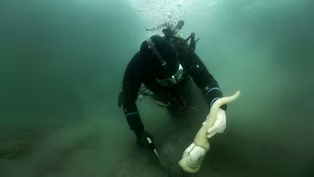
Diving for Geoduck, the World’s Largest Clam
Video has Closed Captions
Clip: S37 Ep5 | 9m 50s | A young couple in the Puget Sound makes a living harvesting the world’s largest clam. (9m 50s)
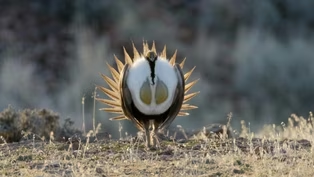
Video has Closed Captions
Clip: S37 Ep5 | 12m 29s | Lithium mining threatens a unique collaboration that’s protected sage grouse for a decade. (12m 29s)
Providing Support for PBS.org
Learn Moreabout PBS online sponsorship














Support for PBS provided by:
Oregon Field Guide is a local public television program presented by OPB