
Market to Market - July 3, 2026
Season 51 Episode 5146 | 26m 45sVideo has Closed Captions
Commodity market and economic analysis with Chris Robinson and Ernie Goss.
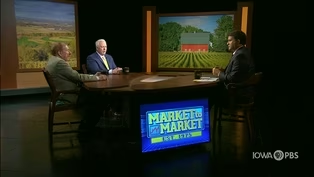
On this edition of Market to Market ... USDA sends two reports into the world this week for acres and stocks. A mid-year review of the economic picture in rural America. And, commodity market and economic analysis with Chris Robinson and Ernie Goss. Recorded: July 2, 2026
Problems playing video? | Closed Captioning Feedback
Problems playing video? | Closed Captioning Feedback
Market to Market is a local public television program presented by Iowa PBS
Market to Market - July 3, 2026
Season 51 Episode 5146 | 26m 45sVideo has Closed Captions
On this edition of Market to Market ... USDA sends two reports into the world this week for acres and stocks. A mid-year review of the economic picture in rural America. And, commodity market and economic analysis with Chris Robinson and Ernie Goss. Recorded: July 2, 2026
Problems playing video? | Closed Captioning Feedback
Where to Watch Market to Market
Market to Market is available to stream on pbs.org and the PBS app.
Providing Support for PBS.org
Learn Moreabout PBS online sponsorship>> Coming up on Market to Market, USDA sends two reports into the world this week for acres and stocks.
We'll have a mid-year review of the economic picture in rural America.
Commodity market and economic analysis with Chris Robinson and Ernie Goss.
Next >> [MUSIC] >> I wouldn't be here without my customers.
>> Yeah, I'd like to thank the customers there.
They're very dear to our hearts.
>> It's about the people that you're working with and the relationships that you have.
>> Thank you.
Thank you.
Thank you.
>> Thank you from the bottom of my heart.
>> [MUSIC] >> Tomorrow for over 100 years, we've worked to help our customers be ready for tomorrow.
>> [MUSIC] >> Trust in tomorrow.
Information is available from a Grinnell Mutual agent today.
>> Support for Market to Market has been provided by a bequest from Philip Leeds of Alta, Iowa.
In recognition of public television's commitment to agricultural programing.
>> Market to market is made possible in part by a grant from the Corporation for Public Broadcasting >> This is the.
Friday, July 3rd edition of Market to Market, the weekly journal of Rural America.
>> Hello, I'm Paul Yeager.
Just before America's birthday party weekend, there were two pieces of business from the nation's capital.
The first, the jobs report.
The economy added 57,000 positions in June.
That's about half of last month's gains as lower than expected.
Seasonal hiring took place.
The unemployment rate dropped to 4.2%.
That broke a four month streak of 4.3% unemployment.
Now, to Americans heading out in the family truck, SUV or camper.
The average price for a gallon of gas is three.
84 last month, that price was 4.29, and a year ago it was 3.17.
As you gather this weekend to celebrate, the conversation could turn to the economy.
That's what we're doing this week as we discuss what's happening with inflation tariffs as well as the commodity markets.
Dr.
Ernie Goss is the Jack McAllister chair of regional economics at Creighton University in Omaha, Nebraska.
Chris Robinson is the founder of Robinson AG Marketing based out of the Chicagoland area and a regular market analyst on this program.
We'll get to the two of you in just a minute.
Hold on.
We got to clean things up here and tell you about the USDA Acreage and Stocks report.
It arrived and it delivered corn acres near the same as March and went below trader expectations on the stocks number for the holiday shortened trading week ending July 2nd.
The nearby wheat contract gained a dime and the September corn contract added a penny USDA added a few acres above expectations while being very close to the stocks.
Guess the August soybean contract was even while August Meal put on a $1.30.
December cotton improved by $0.95 per hundredweight.
August class three milk futures lost $0.42.
The livestock market was mixed.
August cattle decreased six.
80th August feeders cut 905 and the August lean hog contract gained 202.
In the currency markets, U.S.
Dollar Index fell 48.
Ticks.
August.
Crude oil sold off a dollar per barrel.
Comex gold was up $44.40 per ounce, and the Goldman Sachs Commodity Index dropped by almost ten points to settle at 61744.
Here now to lend us insight on these and other trends, regular market guests Ernie Goss and Chris Robinson.
Good to have you both here.
Chris, for once you have to wait.
We're going to start with Ernie.
>> Wow.
Okay.
All right.
>> What's the state of this economy here midyear.
>> The economy is moving along a bit better than what I expected.
The the quarter the last quarter numbers were revised up.
GDP number from 1.6 to 2.1.
We should be 3 to 4%.
But 2.1 is probably one of the best on the globe, where the U.S.
Economy is moving forward, but it's moving forward, in my judgment, for not some of the.
We'd like to see some other factors driving it.
It's a lot to do with data centers that growth in AI.
And that's, of course, investment.
That's a portion of GDP.
And you can't eat a data center.
Okay, I'll put that in there.
>> You you can't.
But there is a traitor who's famous for being on the other side of trades right now.
Dr.
Michael Berry has shorted the AI sector because he thinks that bubble is there.
Is the bubble about to pop on this.
>> I don't think it's about to pop but it's certainly there.
It'll take some more time than what in my judgment again.
And what we need to see is some more consumption.
In other words, the C of the GDP is C plus I plus G plus net exports.
The reason GDP is up there for the revised upward because imports were down.
In other words, we we're buying less and less goods from abroad.
And that's.
That pushes up the GDP.
The real problem.
According to our surveys we conducted at Creighton University, the two sectors of the ag sector and the manufacturing sector.
Both are indicating job gains are just not there.
In other words, we're seeing a lot of GDP, not a lot.
But GDP growth is solid.
I'll call it solid.
Job growth is not solid.
We lost manufacturing jobs and that's underreported.
You don't hear much talk about manufacturing jobs being lost.
>> So if unemployment, which has been staying at 50 year lows for a number of years now, are people just retreating from the workforce?
>> They are.
That's some of it.
But also the individuals undertaking, instead of going into claiming unemployment benefits or signing up for unemployment, they're saying they're taking jobs.
As an Uber.
I rode the other day with an Uber driver who's doing Uber, and in the evening he's working in a fast food place.
It's combining, so it's not a good picture.
In other words, the unemployment rate is not indicative of what's really going in the economy.
But I don't want to put the economy down.
It's still 2.1%.
GDP growth is reasonable.
But again, a lot to do with data centers.
We need consumption up there.
The problem with consumption is the lower 80%.
Their consumption is down the upper.
Those who get benefits from the stock market, they're they're seeing those.
That's we're seeing growth there.
More growth.
>> Since the last time you and I spoke on television to each other.
This Iran situation started, maybe ended, might start again.
We saw the inflation on commodities prices were up in May was maybe what our peak is.
We'll get Chris's take on that in a minute.
But what is the long term hangover going to be from what just happened in Iran?
>> Well, oil prices are still going to be moving upward.
You got to have restore those reserves that are brought down.
So that's part of it.
You're still going to see oil prices a bit higher.
Gasoline prices will come down.
Rent prices will come down.
That's good on the inflation front.
But nonetheless we're going to see higher higher inflation going forward.
And Warsh, the new head of the Federal Reserve, says, hey, we're here to keep inflation at 2%.
Good luck on that.
Mr.
Warsh.
It's not going to happen.
And they haven't done it in five years.
So but we're going to do it now.
Yes, sure.
We'll see it.
I'll believe it when I see it.
>> Chris, is inflation out of the commodities in your eyes.
I'm sorry.
Iran and inflation and that inflation that Iran caused.
>> I think so.
I mean we had that spike up.
I don't think we would have had 5 or 6 these corn if it hadn't been for $120.
Crude oil.
We I don't think we would have had $12 beans if we hadn't had.
And you see, the market corrected quite severely after that.
So you also had a lot of money flow speculation coming in because like, okay, here we go.
We're going to have the inflation trade again.
So that was became a popular trade.
You know, people talk about the managed money.
They were along 300,000 contracts of corn at the top, 200,000 contracts of beans at the top.
We didn't have the China meeting come through with a big sale.
It was they just let the air out of the bubble.
And it was a quiet first.
It was a quiet exit.
Then it really hit.
Now they flipped and gotten short.
As of last week, they were short 70,000.
So that's 3.5 billion bushels of corn that they sold as a speculator.
So I always talk about this in my letter.
You know, people love the speculators when their bet with you, but when they leave, they don't give you a text message beforehand.
So I think what drove that was the crude oil coming back down to we're back where we were before the war started at 68 bucks.
Are we going to go back to where we were in Christmas at 55?
Just remember that when we were back here, we come here in Thanksgiving, crude oil was 55, 60 bucks for a while there.
So for now, I think that's the driver.
And you're right, we'll have to see how how the rest of the year unfolds with Iran, because every weekend, every Sunday night, it's there.
There's a new tweet that we have to deal with.
>> Its volatility, a lot of volatility.
And that's that's not good for the the agricultural sector, not good for the manufacturing sector.
And as Chris said, look at exports.
I mean, exports to China.
We're back up a bit 25 versus 24 up for China, but not compared to 2024.
We're not even close.
We're still lagging those exports that we were selling for soybeans to China not there yet.
And we're moving in the right direction.
And that's part of it.
But not fast enough for my comfort.
>> Do you?
Let's stick with energy for just a minute, Ernie, because one of your surveys really kind of is in areas and energy is a part of it.
Talk about a production standpoint in this region, whether it's renewables or traditional energy and the consumers of that, which of those sides of the ledger are screaming the loudest right now?
>> I'd say the consumer, because we're back to the data center.
I don't want to keep harping on that, but that's pushing up electricity prices.
Electricity prices are growing at 6% a year.
That's far, far too quick for most individuals and families out there.
And that's driving that's pushing down consumption of other goods.
In other words, buying clothing, buying even food.
We're seeing cutbacks there.
So the consumption back to that C plus I plus G, the C, they're that big 67% is not where it should be.
And it's the GDP is being held up again.
I'll say it again the fourth time data centers you know.
>> Chris, in the regions on the west side of what Ernie talks about wheat country, they're using a lot of electricity to find some water pumping a lot.
If it's even there, the wheat market hasn't really found a harvest.
It's having harvest pressure, but it's not because of what's in the United States, of coming in.
What is the biggest reason?
Wheat, though, rallied this week?
>> Well, I think it was more of a relief rally, too, because we had you have to remember, we started out the year in January.
The funds were short 150,000 contracts of wheat.
We were at or near three year lows, multi year lows.
The market was very, very oversold.
And then we started hearing about, you know, it was too dry for the winter wheat and everything else.
And we had a tremendous rally.
It was a great rally.
We had year one and a half year highs, $7 wheat, you know, September Chicago soft red was seven bucks.
And then it was funny as as that went away it wheat does what wheat does.
We dropped $1.50 you know.
So it's again, it's one of those things.
And yeah, now we're worried about what's happening in Europe.
We're going to see what happens after this long weekend.
If they keep having that's in the headlines because there's a big drought in Europe.
But Europe's not the United States.
That could be supportive also for the prices recovering.
We did get that little bit of data that this was the smallest number of winter wheat acres we've planted since 1877, 150 or something like that.
So, you know, farmers have, you know, backed off from it because who wants nobody really wants to plant a $5 wheat.
>> I don't I guess I don't ask this question to you, Ernie, but talk about those regions that do rely on the wheat business.
That's going to be a change for them to not have wheat being into the fields.
What are some of these areas going to do?
Is this going to hurt?
Is there going to be some side effect to the the overall economic picture for some of these?
>> There already are side effects, Paul.
In other words, in our survey of bank CEOs in rural areas of ten states, 27%.
Now that's the number of businesses on what we call rural main Street are hurting right now.
And that's, of course, not good for the overall rural economy.
And we're seeing that already.
And it it is not very what we.
Now look, I'll avoid the question to some degree.
I just say that we ask the bankers, what is the number one thing that the agriculture sector needs to see?
And number one, was get some control over these tariffs.
Get, get reduce the tariff levels with our trading partners, reduce our own tariffs.
For example we're talking about fertilizer coming into the U.S.
Those tariffs on fertilizer, tariffs on steel and aluminum from Canada, all those that goes into, of course, agricultural equipment production.
All of that is pushing up prices.
At the same time, the farmers commodity prices have not kept up.
Back to your wheat.
Yes.
>> Particularly this week.
The president said there was going to be some relief on one of the fertilizer import tariffs.
What's that going to do?
>> Well, it's going to help longer term.
I think the also I think they talked about putting $500 million towards that, that I think the one thing they should really concentrate on is, is it's urea.
That's the most important one that we need to get production back here in the U.S.
So we'll see if they can do that.
I think they're trying to do the right thing.
I think they're trying to help that.
You've already seen the inputs like that collapse.
In fact, there's a lot of people that are upset about it.
Excuse me, but, you know, as basically it went right with crude oil.
Crude oil went to the roof, everything up.
So now you've seen a little bit of back off there.
So it makes it very, very hard.
We did talk about this, I think in February.
You know, a lot of a lot of producers really had already had their fertilizer down.
And then I think maybe there was 10 or 20%, the guys that didn't do it.
So that was the one interesting thing from this report.
We had all been believing or wondering, did we lose 2 million acres of of corn production or not?
It didn't show up in this report.
That was the one surprising thing.
And that's going to be what we're going to watch the rest of the year.
Did we actually lose corn acres because of fertilizer?
>> Take a drink of water while I ask this long question, if.
>> You need to.
Thank you.
>> There's a there's a sentiment online that these acres aren't necessarily from pulling up fence rows, but it's areas that don't normally grow.
Corn expanded and it does it tie back to the wheat area that knew what the situation was and instead went with corn.
>> Yeah.
Well, I think you hit the nail on the head there, I think, and we won't really know for three, 2 or 3 more months when that when the final tally is in.
A lot of people were surprised that are, yeah.
Are there any others besides me that they did not adjust corn acres and they still may.
>> Let's talk about corn quick.
Talked a little bit about the acreage story.
That's the December contract right now.
Let's get into the weather situation.
It was hot but there's rain in the forecast.
And traders don't like that to combo.
So is our weather window rally closed?
>> No I think it's the drought window is over because we got we had two weeks of rain.
In fact, everybody that I talked to in the last week.
You know, there's puddles out there and guys are driving around, you know south of Champaign and stuff.
And the beans don't do well when it's wet.
And the guys like, look, he goes, I don't know.
He goes, we're not going to reprint, replant.
Also, I think depending on when the corn got planted, some some guys, you know, that I talked to in Indiana, they're not going to bother to replant because they had so much water.
Now the question is, will they spray the fungicide?
And most guys I talk to, they're like, we're going to do half and half.
We're going to see what happens because the risk is now you've got you had too much water.
You don't have a good root structure, right.
And then you get heat.
So if you throw that in, what does that do?
It lowers yields.
So that could be what lowers yields moving ahead.
And also too if we get anything like tar spot or anything like that picking up.
So at this point that's what the farmer needs.
We need a cut and yield.
Carryout was still healthy after the USDA report.
So to get higher prices, we're going to have to need two things.
We're going to need more demand, which we keep wondering, is China going to show up?
Last week, there were some rumors that they were going to come in.
They haven't.
If they ever came back in, I think that would be it.
You combine if we get some Chinese demand and a little bit of wheat stress, weather, stress, then we could get a recovery.
>> Before we get to beans, I'm going to ask Boyce in North Dakota's question if I could please.
And he is wanting to talk about positioning ahead of the weekend, where the corn and bean numbers good enough to justify continuing this positive trading, or is it just a little short covering ahead of a long weekend?
>> Well, the only positive that I can see is the funds are short now, 70,000 contracts, which is you need that because they're short.
If we do get a weather issue or a demand issue, they won't hesitate buying back.
They did it in January, January.
They were short in the hole and then they bought it all back.
That's one reason we went to our highs.
So I'm hoping that we get an issue like that for now.
You know we had an an 80 cent drop.
This trading range this year.
506 to you know, we made the low right before the report for 25.75.
That 75 or $0.80 if we're lucky, I think we can get a halfway back, maybe a 40 cent rally.
And then we'll see.
And then if we do get a weather issue, maybe we get one more shot at $5 corn.
Hopefully this time guys won't hesitate at five bucks.
>> Ernie.
Chris is kind of alluded to China a little bit from the outside.
I mean, yes, commodities needs to be part of your answer here, but from the main rural Main Street perspective, what does China's interest or lack of interest that we've seen recently mean for some of these rural businesses?
>> It's very important.
In other words, that, again, we're compare exports of livestock and agriculture to China today.
The first four months of 2026 versus the same period in 2024, we're off 68%.
Paul.
That's that's.
>> That's significant.
>> That's a heavy burden for agriculture and how it spills over into the broader community, whether that's the equipment manufacture, the equipment dealer, the restaurants, and so on.
It's it's tough right now.
And what what I think we need to see is more stability instead of volatility.
And the Iran situation, not that's caused a lot of volatility.
Now of course that goes outside of my area of expertise.
I wouldn't want to comment whether we should or should not have done it.
But from the agricultural standpoint it's tough.
It pushed up prices.
It's caused us to look inward.
And Paul, the real issue here.
Well, one of the issues is that, to quote the Robert Frost's poet, before you build a wall, you better find out what you're walling in and walling out.
And unfortunately, we haven't done that.
We have the most productive agricultural in the face of the earth, the most productive manufacturing on the face of the earth.
We produce far too much for the domestic market.
We have to export.
So keep that in mind before we start closing down markets.
>> Well, that's that's the next that's the next six hours of discussion there.
We haven't even mentioned Usmca, which I said we were going to.
Chris, I need to move to beans for a minute because it's China.
The only thing that's going to I talk about whether is the corn thing is that weather for beans or corn, China, that's the bigger story.
>> I think it's China for.
And also to the one thing we've seen all year is the beans have held up very, very well compared to corn and wheat.
We had a tremendous rally and a lot of people were trying to wonder what was the market planning?
Why were people looking at, you know, we went from 1050 beans to a little over $12.
That was a great, great gift of a rally.
We had 30 month highs.
You know, nobody expected that.
Certainly after that January report.
And I think the driver were two things.
You have the biodiesel, which is have has, has helped the demand for the crush.
When he crushed the beans for the for the, the bean oil.
That is something that's you look at bean oil.
Bean oil is the most beautiful chart out there.
It looks like cattle.
Right.
And I'm that's I think one thing that's been very supportive for soybeans also to the price, the demand for beans has been pretty good.
And China still, you know, they bought what they promised they were going to buy earlier in the year.
They still haven't come for the 25 million metric tons.
That's a billion bushels.
And for 20 years, that's what they did.
They we grew 4 billion bushels.
They took a billion bushels.
That was sort of the deal that we have.
They still haven't come in yet, you know, and we're sitting here today still at 1150 beans.
So that's a positive right there.
The best looking out of corn beans.
The beans look the best.
And that's been the one silver lining.
And I think if China comes back in because China's not you know, they're not they're not not paying attention to prices.
I think they may come in sooner rather than later because every day it waits that they're, they're, they're betting that we don't get a weather with you if we get a weather issue.
And then you throw in China demand, then you've got a real market.
>> And if we don't get either of those, $12 is off the table.
Pretty much.
>> Yeah.
Well, I can tell you what.
>> The this year we've had 1050 beans to 12, 14 beans, anything above 1080 or excuse me, anything above 1061 that was in the upper 30% and we're right there.
We're at 1050.
So beans are the best looking marketing opportunity I can talk about.
>> Can you say the same about cattle and the consumer right now trying to deal with high beef prices?
>> Of course.
I mean, we're seeing, Paul, food processing plants across the region and across America are closing down and and cutting back on production.
And that has some real impacts across the region, and especially in terms of beef.
We're talking about beef, the closure of the Lexington plant in Lexington, Nebraska, 3200 workers out of work, 8000 workers in food production are gone.
In the region, the region we surveyed ten states, and that is something to do with the lack of beef coming in.
In other words, the consumers there.
But the production is not.
We're talking about cattle herds at Dec many decades low.
The question is, will those herds come back and will we have the processing capability, or will the farmer have to transport that that cattle to a distant production facility?
>> I'm going to tease it.
I will talk about USMCA and plus, but I need to get to the because there's a huge part of that story involving Mexico and the border, $9 off in the in the feeder market this week.
And it's only a 2%.
So are we letting off some steam before another run higher?
>> Well, we're still.
>> At or near all time record highs.
And also to the day they announced the the New World school worm.
That was January, January, which was January 4th.
It was June 4th.
We spiked.
We rallied 35 bucks.
Since then.
40 bucks in the feeders, fat cattle.
So the market has figured it out.
Had already priced it in and came right back at it.
And we've talked about this for a year and a half now.
The consumer continues to buy beef at the grocery store.
So that's the one amazing thing.
>> But the farmer overall is not seeing it.
I mean, in other words, we farm income is still there.
We need we need, again, open up these markets.
But also what about the beef production?
The consumers there we I talked about a weak consumer, but in beef they're there right now.
They're the protein demand is there.
>> So and in the hog market.
>> Hogs have just gotten absolutely hammered.
I mean they're at 14 month lows in July.
We had a little bit of a bounce there.
Now I if you look at the long term demand for hog, it's usually pretty inelastic.
But technically you've seen this move where the funds are all.
Again, this is where money flow comes in.
They continue to be bet long cattle and they've flipped and gotten short the lean hog.
So hopefully they're.
We're due for a recovery.
Lean hogs, but lean hogs have had a tough, tough four months.
I mean really.
>> Well guess what?
We're out.
>> Of time.
Out of time.
>> Chris Robinson great to see you.
Thank you so very much Dr.
Goss.
Thank you as well.
I will ask you about USMCA in just a minute.
Hold on.
Be happy.
All right.
Is there any goss Chris Robinson you've been watching the analysis portion of our program.
In a moment we'll continue our discussion in the online only segment.
Find that by searching Market Plus with Ernie Goss and Chris Robinson.
Wherever you get your podcasts.
You can also go to our website at markettomarket.org to listen.
Now, this weekend is the Fourth of July and our annual event of posting your pictures from a cornfield.
We've long past knee high by this time, so why don't we ask that you and a friend go out into the cornfield and take a picture of how things look at this point in the growing season.
So post your photo in the comment section of facebook.com slash Market to Market.
Show when you're prompted next week.
A squid squabble off the Oregon coast.
Thank you so much for watching.
Have a great week.
>> [MUSIC] [MUSIC] >> Market to market is a production of Iowa PBS, which is solely responsible for its content >> Market to market is made possible in part by a grant from the Corporation for Public Broadcasting >> Support for Market to Market has been provided by a bequest from Phillip Lee of Alta, Iowa in recognition of public television's commitment to agricultural programing >> [MUSIC] >> I wouldn't be here without my customers.
>> Yeah, I'd like to thank the customers.
They're.
They're very dear to our hearts.
>> It's about the people that you're working with and the relationships that you have.
>> Thank you, thank you, thank you.
>> Thank you from the bottom of my heart.
>> [MUSIC] >> Tomorrow, for over 100 years, we've worked to help our customers be ready for tomorrow Trust in tomorrow.
Information is available from a Grinnell Mutual agent today.
>> This week on market to Market, a squid squabble off the Oregon coast and commodity market analysis with Ted Seifried Market to Market.
The weekly Journal of Rural America >> [MUSIC]
 New
NewMarket Plus with Chris Robinson and Ernie Goss
Video has Closed Captions
Clip: S51 Ep5146 | 13m 25s | Chris Robinson & Ernie Goss discuss the economic & commodity markets in a special web-only feature. (13m 25s)
Providing Support for PBS.org
Learn Moreabout PBS online sponsorship New Episode
- News and Public Affairs

Top journalists deliver compelling original analysis of the hour's headlines.
 New Episode
- News and Public Affairs

Today's top journalists discuss Washington's current political events and public affairs.

 New Episode
 New Episode
 New Episode
 New Episode
 New Episode
 New Episode

 New Episode
 New Episode
 New Episode
Support for PBS provided by:
Market to Market is a local public television program presented by Iowa PBS