Us As We Are
Justice for Hakiym
Season 6 Episode 1 | 1h 26m 25sVideo has Closed Captions
Following the "Justice for Hakiym" exoneration movement.
A special report on the Justice for Hakiym movement, a national campaign and grassroots movement dedicated to securing the release and exoneration of Brian “Hakiym” Simpson, a Black, and partially blind CAL FIRE engineer and wildland firefighter.
Problems playing video? | Closed Captioning Feedback
Problems playing video? | Closed Captioning Feedback
Us As We Are is a local public television program presented by SOPBS
Us As We Are
Justice for Hakiym
Season 6 Episode 1 | 1h 26m 25sVideo has Closed Captions
A special report on the Justice for Hakiym movement, a national campaign and grassroots movement dedicated to securing the release and exoneration of Brian “Hakiym” Simpson, a Black, and partially blind CAL FIRE engineer and wildland firefighter.
Problems playing video? | Closed Captioning Feedback
Where to Watch Us As We Are
Us As We Are is available to stream on pbs.org and the PBS app.
Providing Support for PBS.org
Learn Moreabout PBS online sponsorshipOnly a few people have the mental and physical and even spiritual capacity to do this job.
When your body gives up, you know, you need to have that mental strength to push through.
When your mind's fried and you're just tired of, you know, walking and hiking and taking fire lines for 14 hours.
Then you have to have something that you care about, you know, that spiritual aspect, that visualization of whatever it is that you believe in that is bigger than you.
Hello.
You have a call at no expense to you from Hakiym An adult in custody at Snake River Correctional Institution.
Hello?
Yes.
Can you hear me?
If you live up and around Oregon, especially Southern Oregon, then you might have seen this poster.
Or this one.
Or maybe you saw these posts on social media, or maybe ended up with a slice of bread from the farmer's market that was packaged like this.
In mid-2024, when I started seeing posts about Hakiym and hearing mention of Hakiym.
So every penny goes to Hakiym's support fund, which will be used for things like phone, video calls, visitation.
I started investigating.
I'm a firefighter, a spoken word artist.
Father.
Back in the summer of 2024 Hakiym was working as a wildland firefighter in Southern Oregon.
Taking nature in.
Happy Mother's Day to Mother Nature too, you dig?
When he was arrested and imprisoned And he's the one that ended in prison for almost six years, and that's where he currently sits.
For allegedly assaulting a fellow firefighter I'll be frank.
He did beat him up pretty good.
Hakiym claims he was not an aggressor, but rather the victim of a racially motivated attack.
For the other guy who started being mean and racist to my dad.
He said, "you f***ing n****r."
He also admitted under oath that he threw the first punch at Hakiym.
Supporters have rallied around Hakiym into a grassroots social movement.
So I started very, very, very small with a Facebook page.
I have been trying to circulate his story amongst my network up in the Portland area.
We all just said there's no way that we can't be involved in this.
Something like this happening to Hakiym can happen to any of us.
Hakiym's alleged mistreatment by the justice system evokes old demons in Oregon.
Oregon's history of racial exclusion.
Grants Pass was a sundown town.
We were targeted for incarceration and family disqualification.
Mass incarceration in Oregon continues to be a moral failing.
And one of my best friends is sitting in prison.
I literally sat behind my computer and was crying.
If this is how our system is going to be working, we're all in danger.
As Oregon struggles to reconcile modern attitudes with a troubled past And we are now a Sunrise community.
More committed to the ideals of truth, justice, and reconciliation.
Again, that emotional scarring that it's like reopening a wound that just cannot heal.
This is a story with potentially far reaching implications.
What does it mean to be an Oregonian?
I have been an American man.
But there is an individual, Hakiym, who we first need to get who we first need to get to know.
Us As We Are is made possible in part by the Roundhouse Foundation, a private family foundation that supports creative solutions to the unique challenges associated with rural culture and the landscapes of the Pacific Northwest.
And by the members of Southern Oregon PBS.
Thank you.
Please make your way to these seats in the middle.
We're going to begin.
We are here tonight.
CROWD: We are here tonight.
To make a wrong, right.
CROWD: To make a wrong, right.
You can write letters, notes, drawings that'll be photocopied.
They'll be sent to Hakiym, and Hakiym's poetry is on the wall.
So you'll see those right there.
Each one of those is like, okay.
This is a fundraiser.
Right?
So each one of those is actually for sale.
Artwave is more than just an event.
It is a movement.
It is a night where we come together as a community to use our voices, our creativity, and our collective energy to stand for justice.
The story that we're gonna be sharing and speaking on this evening is an intense one.
It's very much about Hakiym, currently incarcerated in a dreadful, dreadful place.
It's also part of a much larger picture, right?
It's deep, it's old, [Hip-Hop music] Hi, I'm Dorothea Simpson.
I am the mother of Hakiym Brian Edward Hakiym Simpson.
I live in Cincinnati, Ohio He was this bouncing baby boy who was always smiling, always happy.
I did have him at a young age.
I will say that I had him at a young age.
Hakiym is the oldest.
And then there's Dominique Simpson.
I spent a lot of my time in my teenage years with my brother.
Definitely helped support me and make sure that I was going to school and get me on to college even.
You would not know that they were ten years apart because everything the siblings do, that's what they did.
They have always been close and tight.
Exposed me to a lot of the art culture in Cincinnati.
When I say spoken, you say word.
Spoken.
You know, I was a I was a kind of a, as they say, nerd in school.
I liked English.
I liked reading.
It's time to free the dome.
Freedom.
Freedom.
And establish a culture.
Governments are toppling over.
I would turn on some music, and we would get up and make up our own little rhymes.
And I don't know if you would call it rap, but, yeah, rap over beats.
And so music and musically inclined has always been in his life.
I'm a soldier infiltrate the disseminate the truth in the streets, so don't sleep.
I've known Hakiym for about 20 years when I was in my undergraduate program at University of Cincinnati.
He just kind of walked over to me in a coffee house and started talking to me about a book on Buddhism that I was reading.
Like, he knew me for a million years, and we were well acquainted, but we're strangers, and we've been close friends ever since.
The drumbeat of police batons on riot shields.
Inside.
Inside.
Disperse.
The fatal police shooting of a 19 year old African American during a chase sparked the explosion.
*inaudible* We're ready.
So after the riots in early 2000s when Timothy Thomas was shot and killed by a police officer I just got shot in the back with one of them things, and when my back turned like they did my friend downtown.
They kill us, man.
They murderers, man.
After that all happened, Hakiym felt it was really important for there to be an outlet for young people to just voice their opinions, but also embrace that art.
So he actually helped start a place called Elementz.
That was our aim, to work with people that are ages 14 to 24 years old who are at risk.
Like an after school and weekend program for inner city youth, and they have things like recording equipment, vocal coaches, spoken word, all kinds of just really amazing things, and that's still in operation today.
He had some hip hop seminars.
He was able to speak about how hip hop integration with education was instrumental.
You know, the most important thing is that these young black men and women know that they can be heard in a way that doesn't demonstrate violence or rioting or looting.
It's they can be heard in peaceful ways.
Martin had a dream.
Hakiym got a dream.
Yeah.
All my life, I want money & power... I saw him grow from the rough childhood that we had and that he had and, you know, he was able to turn that around.
You know, grew up in an urban environment where I've made mistakes and things of that nature.
So I was like, how can I help those people around me that don't have a figure to look up to?
[Peoples minds are blind confined by weak rhymes] [Transition.
Our paradigm is shifting] I was part of the 2004 hip-hop political convention where I ended up running into artists that were running a organization called Hip Hop Congress.
I ended up becoming a chapter leader in Cincinnati, Ohio for that.
Hip hop kind of just what we do, man, all over the nation.
I have to go with you right now.
Basically, to give the hip hop community the tools to empower itself to create social, economical, political change through that social development.
There you are.
You know what time it is?
Look around.
2015, at that time, they wanted to have more murals of black men painted in Cincinnati.
And as a positive role model and community leader in Cincinnati, I was chosen for one of the murals.
We were just very proud to see that.
I'm proud to show my daughter that it and my son that, you know, uncle Hakiym has a spot on Cincinnati, and he's recognized for doing something.
[Hakiyms music] Another aspect I would probably say would be my spirituality as far as being a Sufi.
So there's an Arabic word that's called khidmah.
Khidmah literally means service.
So one of the aspects of being a believer is to be a service to your man, to other people.
The first and foremost of all commandments is love.
My my favorite anime is Naruto because that's the first anime that my dad put me onto.
And he loved Naruto, like, a lot.
He loved, like, the spirituality and all the things about Naruto.
He got to guide me through my childhood.
Even when they separated, I lived with him for a while.
Just me and him in Cincinnati got to connect on a different scale than everyone else.
We just like we had the same things that we liked.
He cooked good meals.
I liked to eat good food.
Even when he moved to Oregon and started becoming a firefighter, texted, like, every day.
Well, it was the year of 2020.
I was doing some political organizing and the organization I was working for would fly you around to different states.
You would stay there for like 3 months.
He was actually doing door to door campaigning for voter registration.
He went from up north some kind of way down to Texas, and before you know it, next thing you know, he was in California.
And so I got to California February 7th of 2020.
Well, March 20, everything shut down.
We direct a statewide order for people to stay at home.
I'm like, what job does not shut down?
What can I do to continually be of service to the community?
And that's when I got the idea of why don't I try to become a firefighter out here.
Then I finally found the Buffalo Hand Crew through an organization called FFRP.
Non profit organization, FFRP.
That's where I started training with.
Calvion Lee would soon become friends and roommates with Hakiym.
They met his coworkers in firefighting and began their careers through a similar route.
Mhmm.
So it's a program to get you recognized as a regular person instead of a inmate or someone else in jail or someone that who has a record.
Hakiym was in FFRP because of a tangentially related legal situation that'll be explained shortly.
We all here.
Graduation day.
So I graduated from that Wildland Academy with the Buffalo Hand Crew in Pasadena, California.
And at night, I catch a flight back up to the Siskiyou County up near Oregon for another firefighter program for CAL FIRE.
When he told me what he wanted to do, it instantly took me back to when, I don't know how old he was, 8 maybe.
We went to the fire museum and he was so excited to see the old fire trucks.
He was able to be sworn in for CAL FIRE.
I, Brian Simpson.
*phone* Do solemnly swear.
Hakiym: Do solemnly swear.
I got to witness that myself, and that was really great.
So help me God.
Congratulations, sir.
Your time at fire service starts today.
Thank you so much.
So around that time is when Grayback Forestry reached out to me and they said, like, hey.
Are you still interested in coming out and fighting fire?
And I said, sure.
After training, Grayback was the first people to pick me up from the applications.
Okay.
My name is Reyes, Reyes Aguilera.
I'm from Grants Pass.
I worked with Hakiym at Grayback.
We weren't on the same fire crew together, but we did do a lot of project work.
And I mean, got to know him pretty well.
I mean, he's a really good person in his really bad situation.
I've heard this case a lot, and and every time I hear it, it gets to me.
Due to ongoing legal proceedings, Hakiym himself was advised not to comment directly on the incident at the time of recording.
The following reconstruction of events has been assembled from a combination of transcribed court testimony and my own documentary interviews.
Brandon Olson is discussed extensively as a key figure in court proceedings and media coverage following the incident.
I tried for months to contact Mr.
Olson for comment on this story, but never received a reply except for being blocked on Instagram.
Everything said and shown of Mr.
Olson in this program is derived from statements made in open court and publicly available social media activity at the time of recording.
He is a man that Hakiym barely knew.
The barracks is a sprawling thing.
There's a bunch of different crews on.
Everybody knows each other.
They'd never worked on a crew together.
They'd had a few interactions, which I'll get to.
Mr.
Simpson first met Mr.
Olson in the 2023 fire season while conducting fuel reduction work with Grayback Forestry.
As a Grayback Wildland firefighter, your job is to protect the American wilderness, forests, and nearby communities from wildfire.
Before the incident, it was just basically project work, just trying to figure out how to get on a crew.
The job is difficult, physically demanding.
With long hours and extreme outdoor conditions, you will be challenged mentally and physically.
It was rough, but that was the way that you can get recognized to get on a crew.
I also knew who the other guy was, and, I mean, I worked with him, actually, probably more than I worked with Hakiym the summer before, and I was really surprised when I heard it was him because I mean, not that I didn't know him as a person, but just that I was surprised that they brought him back because all the stuff that was going on with him previously.
Suicidal thoughts that he'd shared with everybody, so he ended up getting sent home from the the fire that we're out together on.
Probably should have been taking care of some other things before he was out there working.
During the summer season, firefighters customarily live in company provided housing, which for Mr.
Simpson and Mr.
Olson was located at Paradise Ranch in Merlin, Oregon.
Most firefighters are in these 2 buildings.
A long driveway curves around this pond leading to the main ingress point for the property.
Because it was we came early.
We came in April, so it wasn't really nobody there at the ranch like that.
It was only like a a good 20 people.
The only known major interaction between Mr.
Simpson and Mr.
Olson occurred after Mr.
Simpson returned to Paradise Ranch after horseback riding in May 2024.
I've seen Hakiym pull up.
I've seen Olson in the parking lot, but I wasn't in their conversation.
Mr.
Simpson likes horses and was at the time wearing a cowboy hat with boots and spurs.
Mr.
Olson allegedly made some comments about this.
I was already on his head too about wearing the the cowboy boots.
You know, he was clean.
It made me wanna go get me a cowboy hat and some boots.
After Mr.
Simpson told Mr.
Olson that he does ride horses, Mr.
Olson allegedly asked Mr.
Simpson if he knows a woman named Sharon.
He did not know Sharon.
The tone of this conversation was reportedly awkward or maybe a bit tense.
Yeah.
He told me what Olson said, and it was kinda funny.
He actually laughed himself, but he was kind of like, why did he just say that to me?
Later on June 16, 2024 Mr.
Simpson returned to Paradise Ranch after working at a controlled burn in the Fremont-Winema National Forest outside Lakeview.
The next day, June 17, was a day off.
Everybody meets up in the parking lot to go hiking.
Brandon's there.
Basically, the whole people that was in the situation was there.
Everyone dispersed into their own groups.
They went bowling, I believe, and then they cooked out and they had all this food.
Everybody don't have money.
Everybody's coming from a different state or country or across the world just to work at Grayback.
So it's kinda everything is coming out of your pocket.
So that day was just, you know, just appreciate everything.
It was cool until the wee hours.
Olson wasn't there.
If he was, he was in the room.
He never came out till later on.
Folks started to split off and head back to their rooms around 8 or 9 PM.
Well, I laid it down at 8, so they was still barbecueing and I was tired.
So I went to the room.
Olson claims to have gone to bed around 9PM, watching YouTube videos until he fell asleep.
Olson heard noise keeping him awake.
And when he woke up, he stepped out into the hallway.
He's going to address the people that woke him up.
And in his words, as was stated in court, he was grouchy that day.
According to this anonymous witness statement submitted by another firefighter who was there that night, Olsen was witnessed pacing up and down the hall, appearing agitated.
He begins to engage with different firefighters out there, but he engages with Hakiym.
He's basically becoming volatile.
Olson tells them to keep it down.
Someone in the group makes a joke about Olson being an old man due to going to bed early.
Olson sees firefighting equipment, red initial attack bags staged nearby.
And those red bags basically are the bags of the firefighters, typically indicative of a fire that they're being deployed to.
And so he felt as though that he was left out again to be a part of a fire crew.
It's Simpson who responds to Olson about the bags, but Olson describes Simpson as taking on a mocking tone.
This sparks an argument.
It goes from there of others attempting to try to deescalate, but he focuses in for some reason on Hakiym.
Okay.
So being woken up between 12:30 and 01:00 to arguing.
So I peep my head out the door to see what's actually going on.
Rushed outside, you know, boxers no shoes on, no nothing.
And I'm comfortable.
So I need to go see what the issue is between these 2 gentlemen.
Olson describes himself as feeling bullied and felt that if he walked away from the situation, then poor treatment would only continue later.
You can tell that he had some issues going on, and he would just butt heads with everybody.
And he was I mean, I'm an older person on the crew, and he was an older person on the crew.
He would get picked on and bullied.
Hakiym is standing there with his hands behind his back, like, you know, in parade rest.
Talking to him as a man, you know, face to face, nose to nose.
Other firefighters come out of their rooms attracted by the commotion.
He said, you f***ing n****rs.
It was "You f***ing n***a" at first because he was talking because he was talking to Hakiym.
And then when I walked up and, you know, try to, you know, why y'all arguing?
Why y'all fighting each other?
You know?
He's like, “man, f*** you n****rs.” And he took the first punch at Hakiym.
Mr.Olson claims no memory of using racial slurs, though does admit to using some foul language.
He threw the first punch at Hakiym.
Mind you, this was all stated in court.
They was fighting for a minute.
It was, I'm not gonna lie.
It was a good fight.
It was a good fight.
But it was just out of hand because Olson got knocked out twice.
They both charged back at each other.
So it's like, okay.
I can't really do nothing.
Imma do the best thing I can you know, try to break it up, but, you know, it really got out of hand and kicking each other and stuff like that too.
This is where the testimony of participants, victims, and witnesses differs substantially.
Simpson's side of the story has him trying to subdue Mr.
Olson, but that Olson just kept getting back up and kept coming at him.
Other witnesses report Mr.
Simpson caught in rage beating down on Mr.
Olson.
Olson can't defend himself, so now I gotta get back in and break it up.
So it was a couple kicks, and then that was it.
I say 2 or 3 at the most and that was it to actually do what happened to Olson face, but it was more punching than anything.
It was it was it was a fair fight, I say, till Olson couldn't, you know, defend himself.
Mr.
Simpson testified his explanation for this action is that Mr.
Olson had grabbed his leg, so Simpson was trying to wriggle him off.
When he defended himself in the process of doing that, he broke the aggressor's jaw, and he also broke his nose.
After I broke Hakiym up and I got him to, like, calm down, he was actually trying to help Olson up.
I didn't want him to actually interact with him.
I actually got him to leave.
I gave him his car keys, and I told him to get him his car and leave.
I got Olson on the ground already.
He's he's messed up.
His chin is hanging.
He can't even, he's talking, but his jaw is not moving.
So I'm trying to get him to be calm.
I got Hayden on the phone with the paramedics, and then that's when Brian Olson gets up and go to the laundry room to find Hakiym.
Mr.
Olson himself makes a phone call to 911, and despite his broken face, tries to claim that he was assaulted.
And Hakiym quickly jumps in his car and begins to drive away.
Well, there is a quarter mile long driveway from the barracks to the road, to the main road.
The aggressor began to chase him on foot.
But instead of Olson listening to me and actually trying to sit down to, you know, get him some help, he actually ran after Hakiym's car all the way to the front of the gate.
Mr.
Olson tells 911 and later the court that he was trying to find Mr.
Simpson's car to collect its information and/or to prevent Mr.
Simpson from leaving the scene before police could arrive.
Police record the evidence of Mr.
Olson's injuries and get a few statements.
Before too long, Olson is taken away by paramedics who do, according to court records, administer fentanyl to ease Olson's pain.
Mr.
Simpson is elsewhere.
He drives out of Merlin.
He gets into Grants Pass.
He pulls up into Walmart parking lot.
And when he gets into the parking lot, he immediately calls his squad boss.
The squad boss basically told Hakiym, come to my house now.
He gets to the house and his immediate squad boss calls the other 2 bosses and they all have a conversation, and they tell Hakiym, say nothing, do nothing, we're gonna investigate this.
When Mr.
Olson arrives at Three Rivers Medical Center, the ER doctor confirms his injuries are too extensive to be treated locally.
They plan to transfer him to Rogue Regional in Medford.
Toxicology reports show that he was on illicit opioids that night, which helped explain why a witness testified that the way that Olson looked and was acting was not normal.
When asked if he had a history of alcohol or amphetamine use, Olson nodded yes.
The squad bosses did investigate the situation, and they immediately released the aggressor.
They fired him.
Yeah.
The next day, our bosses came out.
We wrote a statement.
Even though he's my roommate, they're looking at me now.
You know, why, what was the cause of it and everything.
And I really I just told what everybody else story was, and and everybody's line you know, it lined up.
We have Hakiym is now back to the barracks as he's been welcomed back.
The police then come.
Hakiym was cooperative with the arrest.
Police take Simpson to the Merlin Substation, where one of the responding officers from the night of the incident meets them to conduct an interview.
He was driven to some rural substation parking lot.
He's questioned while handcuffed in the back of the vehicle.
At least four officers around the car while he was giving his statements seemingly all the while.
Court records indicate that Simpson avoided answering questions directly.
Mister Simpson would testify that this was because his understanding was that the misconduct investigation was taking care of it.
Fidelis ad mortem, faithful until death.
Don't cross the red line.
Hakiym then ended up being arrested, charged with Assault 2.
Simpson would be held in jail in Josephine County from June 19 until early August when the bulk of the criminal trial began.
Mr.
Olson underwent a 6 hour maxillofacial surgery.
Seeking to avoid medical debt, he would check out of Rogue Regional early.
From there, court testimony indicates he went to Arizona to recover with a family member.
By the time of the criminal trial, Mr.
Olson would be recovered enough to testify normally.
It's really isn't what it turns out to be.
It's like, Yeah.
The aggressor threw the first punch.
Yeah.
He chased after him.
Wow.
He had drugs in his system.
Okay.
I looked at it, and it it seemed like a pretty decent self defense case.
Eric Fournier was Mr.
Simpson's court appointed defense attorney.
There's no dispute about at least this part of it.
He admitted, under oath at trial that he was kind of grumpy.
I believe that that was the language he used.
There's some dispute about whether he used the n-word or not.
When he was asked about it on cross examination, he didn't admit it.
He didn't really deny it either.
He just said, I tend not to use that language or something to that effect.
He also admitted under oath that he threw the first punch at Hakiym, and then Hakiym, he hit him back, and I'll be frank, he did he did beat him up pretty good.
Our side of the case was that the guy just kinda kept coming at him.
The trial proceedings began on August 13, 2024.
The judge was the honorable Pat Wolke, and the state prosecutor was Olivia Mendez with the Josephine County District Attorney's Office.
Much of this trial would be focused on the question of whether the incident required Mr.
Simpson to physically defend himself.
And if it did, were his actions proportionate, or did they cross the line into assault?
Testimony was like, okay.
This guy was grumpy.
He was agitated.
There was toxicology before he hit on drugs.
He start you know, he started the fight.
He threw the first punch.
He chased after him after my client disengaged.
Sounds like self defense to me.
Obviously, the prosecution didn't see things this way.
They called 8 witnesses, including firefighters Hayden Latimer and Samuel DeSouza as well as police involved in the investigation and arrest, doctors who treated Mr.
Olson and Mr.
Brandon Olson himself.
Meanwhile, the defense had only 2 witnesses, Calvion Lee and Mr.
Simpson.
The case against Mr.
Simpson is presented by attorney Mendez, casts him as bullying Mr.
Olson, escalating to violence and demolishing his face in a fit of rage.
She brings in his criminal history.
His he does have some prior criminal history.
He had a he had a prior theft and a prior assault.
When I was 15 years old, I got into some trouble with the law.
I was tried as an adult.
You know, I grew up in an urban environment where I've made mistakes and things of that nature.
So that was my waking up period about the criminal justice system, and that's what led me into speaking out against the wrongs that I saw at a very young age.
But there was also something more recently in 2020 while Mr.
Simpson was living in LA.
It was an assault, I think, from California.
He was dating this woman who had, like, just gone through a divorce or something, and her ex husband found out she was with another guy.
So they just kinda gotten, like, a fisticuffs or something.
It was it was it sounded really stupid, actually.
It was kind of just like, okay.
I think in just about any other state, they wouldn't allow that in.
It seems to aim at the angle of my brother coming to this area to cause trouble.
One of the concerns they have when you bring in somebody's criminal history is that you're going to convict somebody for propensity reasons, which is they have a propensity to commit this crime.
The 49 states and the federal government, there is a rule that if you want to bring in somebody's criminal history like that, you have to do what's called a balancing test.
Is it more prejudicial or more probative?
There's one state in the country where it doesn't work that way and I think you can all guess by my facial expression which one it is.
There are some constitutional implications for that.
I have made that argument in another case.
It's kind of working its way through the Court of Appeals now and the Supreme Court of Oregon.
I think this might be the case where if the Oregon courts were ever gonna say, you know, we need to change it, this might be it.
If, you know, something good can come out of this case, maybe that rule in Oregon can change.
Mr.
Fournier presented these arguments in the pretrial period and maintained his objections through trial, but the court largely overruled him.
Attorney Mendez further impeached Mr.
Simpson, meaning to call his testimony's reliability into question by bringing up an allegation that Mr.
Simpson had not disclosed his blindness to Grayback Forestry.
2015, things kinda changed.
I was shot in the eye.
Hakiym Sha'ir dropped to the ground, shot in the eye with a paintball.
He didn't know that, though.
Just saw red, yellow, white coming from his eye.
It was paint, but he thought it was so much worse.
So he actually thought he got shot and was gonna die.
So like I can't see anything like out of it, but it's I guess it basically still looks, you know, kind of normal.
At that point, I started to more of the backseat with doing just like, the voter registration and education until I tried out to be a firefighter.
Mr.
Simpson defends himself on the record.
The Americans with Disabilities Act protects citizens from an obligation to disclose disabilities to employers.
Being blind hasn't stopped him from being an artist and also being able to support the community as a wildland firefighter.
When Mr.
Simpson and his defense bring up allegations about Mr.
Olson's previous difficulty getting along at Grayback, the prosecution's objections are sustained, and further testimony is blocked.
It should've went from the beginning of everything.
The female, the mental health problems that he was having.
Like, I don't know if they brought up any of that.
They basically said you have to ignore it and have the trial on that basis.
Well, that was the stuff that started the actual fight.
So you're leavin out the good information.
So all of this to paint this background that was not discussed at all in court to show that there is a history leading up to this.
I think that it's a system of violence that needs to be changed.
A system that needs to be changed that's creating the violence.
On the last day of trial, attorney Mendez presents a final piece of evidence, a recorded phone call Mr.
Simpson made from jail following the first day of trial.
In earlier testimony, Mr.
Simpson had referred to Mr.
Olson as his brother in fire and even said he forgave what Mr.
Olson had allegedly done.
But on the jail phone with a friend, Mr.
Simpson expressed that he feels like Mr.
Olson put on a pity show in his testimony, exaggerating his injuries.
Mendez argues that Mr.
Simpson is still bullying Mr.
Olson, isn't treating him the way a brother should, and that this demonstrates Mr.
Simpson's animus against Mr.
Olson.
Even as Mr.
Fournier object to admitting this evidence, even while testimony about Mr.
Olson's alleged animus was rejected, Judge Wolke allows this call recording to be considered.
It appears to be a slam dunk for the prosecution.
Jury ultimately found him guilty.
It sounds like the jury decided that he had gone too far in defending himself.
And he was sentenced to 70 months in prison, which is Measure 11 in Oregon, which is true time.
You'd have to do every day of that seventy months.
Way too long.
Way too many years.
And I'm not just saying that just because I'm his mom.
It doesn't sit well.
It just doesn't sit well altogether.
I mean, was shocking.
It was, I wanna say it was disgusting.
He would also be ordered to pay restitution to Brandon Olsen.
The aggressor was never tried, never charged.
Nothing.
Nope.
Olson would even go on to file a lawsuit against Grayback Forestry for hiring Mr.
Simpson in the first place.
Though at the time of recording, it's unclear where that suit stands.
Grayback Forestry did not respond to a request for comment on this story.
They just assumed that Hakiym did it and Hakiym was in the wrong.
There's a big difference between the aggressor and Hakiym.
Well, Hakiym is black.
The aggressor was white.
Most other people involved in the case were white, except the prosecutor.
The prosecutor was, I think she's Hispanic, I believe, but as far as I could tell the jury appeared to be all white.
How much that played a role I'll let everybody else make their own decision.
I think that if there had been a diverse jury as well as the defense attorney understanding the experiences of certain members of marginalized community, the case would have been handled a little bit differently.
People are going to criticize me and say, Oh, you didn't do this right.
You didn't do that right.
I've had cases where there is self defense.
I've won them and I've done kind of what I do.
I felt I did very well in this case.
It just didn't carry the day.
So I'll defend my record.
I feel that I did everything I could and I'm continuing to do everything I can.
There were some things that happened at trial that I think are potential appellate issues.
If you lose a trial, which is always a possibility, you try to preserve the errors.
You try to say, well, I object to this, I object to that.
The idea behind that is it creates a good record, and then when it goes up on appeal, the appellate defenders office can go to that record and say, oh, there was a mistake here, there was a mistake there, and hopefully you get a reversal on appeal.
I've had a number of cases where that's actually happened.
We're hoping that his appeals attorney will speak to those mistakes that happened in court, but it's our job to speak to those other mistakes and try to right those wrongs and to try to change the system, you know, as a whole.
I knew it was fire season.
We'd been in touch and I hadn't heard from him since June.
Finally was able to get ahold of me.
I can't remember how while I was away.
And it was the day before he was convicted.
And so I had talked to him just before thinking everything was going to like, it was wild and I couldn't believe it, but that I thought everything was going to be okay, and it wasn't.
So I started very, very, very small with a Facebook page and an email.
But I also started writing letters.
I knew Hakiym over 20 years ago, living in Cincinnati, Ohio.
He was just a mainstay of that community.
I didn't know he was living in Southern Oregon.
I've been in Southern Oregon for since 2017, and I saw a social media post.
I was rattled by the story itself.
I was looking at his photos and thought, Hakiym, Hakiym, oh my goodness.
I know this man.
And hadn't talked to him for decades.
You know, they started working with a bakery in Grants Pass to put his story on a bread bag.
The campaign is something that's very grassroots, and I think anybody who wants to be a part of it, we come with open arms.
I wanna see Hakiym free.
I care for him as a human being, and I also care for my community, and I want it to be a safe place for a multicultural community.
Just being this far away, not having communication, I've tried to call countless organizations and just help was very hard to come by.
Finally, I emailed Reverend Al Sharpton.
Eric said he also contacted them.
And two weeks later, they contacted Eric.
They got involved.
Finally, after the NAACP kind of put us off, put us off, put us off, they got involved.
And that's when it really started to just grow.
We started seeing news stories.
Oh, luckily, we did find some very great organizations.
BASE being one of them.
This is exactly what BASE is about.
Once you're in BASE for a little bit, it starts to be like more of like a family thing.
You get to help people.
It's a community.
Our equity work primarily focuses on black residents that live here because we know obviously the history of Oregon is one that excluded black people from every aspects of community life.
Those that are black understand it's not something that just went away.
Base plays a critical role that we've been able to be that representative piece where now there is somewhat of a feeling.
I'm not quite there yet, but somewhat of a feeling of a actual community, a specific community for this group.
We've impacted hundreds of black youth, adults, families who now walk taller, dream bigger because they know they belong.
The amount of text messages that were happening between all of our phones as we're on Zoom of the entire community was, can you believe this?
Do you hear this?
We all just said there's no way that we can't be involved in this.
As I was researching, I literally sat behind my computer and was crying.
There's a petition to governor Tina Kotak to exonerate Hakiym.
She could protect, she could grant clemency.
Now she could say, I'm reducing a sentence.
She could give him a full pardon.
She she can do lots of different things, and there's different forms of clemency.
This is the package that includes every last petition.
This is the the Excel spreadsheets of signatures from online, and that's about 2,400 right there.
More people who say, hey, Governor Kotek, you're up for reelection at ‘26.
You ain't getting my vote unless you do this.
It's ultimately up to all of you.
That is very uplifting for my spirit being in this situation.
I just really can't put it into words how much our family is appreciative of their effort.
Hello, everyone.
Hello.
Hello.
Happy Juneteenth.
[Crowd cheers] So we're celebrating Juneteenth in Grants Pass for the third time, and we're really excited to see the way that this holiday has grown in this community.
Today, we're really focusing on Juneteenth as this opportunity to reclaim a definition of Americanism.
The paradoxical irony of freedom being built on the backs of the enslaved caused the foundational concept of Americanism to be defined by the gap between our ideals and our reality.
Founded in 1776, it wouldn't be until 1865 that gap would begin to shorten.
And so we see Juneteenth as an opportunity to grasp both ends of Americanism so that we can pull them closer together to create our ideal reality.
Our ideals are not a contradiction so long as they are a challenge to our reality.
This year, Juneteenth, is particularly significant to me because today, June 19, 2025 marks 1 year of incarceration for a man named Hakiym Sha'ir.
I learned about Hakiym's case through BASE Oregon.
I just felt that feeling in my stomach that says, I refuse to accept that there's nothing I can do.
And so in the preceding months, I've been able to get to know Hakiym, visit him out in Eastern Oregon, and advocate on his behalf around Oregon.
He wanted to reach out, and was really trying to get to know me, and see what kind of work we can do together.
Organizing here in Oregon, what that looks like in some of these former sundown towns Taylor Stewart is the founder and executive director of the Oregon Remembrance Project, which has been helping Oregonian communities with truth and reconciliation since 2018.
When I worked with Coos Bay, we worked with members of the community for about 3 years to publicly memorialize Alonzo Tucker.
Alonzo Tucker was a victim of lynching in Coos Bay in 1902 On June 19, 2021, part of Coos Bay's first ever Juneteenth celebration, we unveiled a historical marker in the community that tells the story of Alonzo Tucker as well as the wider story of lynching in America as a whole.
I tell people that there are 2 dates of significance on the Alonzo Tucker historical marker, 1902 when the lynching occurred and 2021 when the historical marker was unveiled.
And that we can't fully understand the story of Alonzo Tucker, only focusing on the 1902 date.
As his story now continues on into 2020 and 2021, when that same community where his lynching occurred used his memory as inspiration for becoming a community, more committed to the ideals of truth, justice, and reconciliation.
That's how we honor and reconcile Lonzo Tucker's lynching by changing the ending to his story Now therefore, I, Michael Zarosinski, Mayor of Medford, do hereby proclaim June 19, 2025 as Juneteenth Celebration Day.
Celebrating Juneteenth in Oregon is a unique experience because on June 19, 1865 African Americans were free to be citizens all across The United States, except for one place, the state of Oregon.
It was illegal to be Black in Oregon until 1926.
Those exclusionary laws have evolved over the course of our state's history from foundational laws to sundown towns to restrictive covenants, redlining, gentrification, physical displacement, and the contemporary experiences of cultural expulsion that individuals of color and African Americans still experience in our state today.
So I am here on behalf of Oregon Black Pioneers, Oregon's only historical society dedicated to preserving and presenting the experiences of people of African descent statewide.
And as a part of that, we get to be a part of huge, beautiful celebrations like this to celebrate the stories of Black Oregonians, in the past and today.
One of our goals is really to dispel the myth that there isn't Black history.
There is Black history here in Oregon.
There has been Black history here in Oregon since non native history began.
Those early pioneers like Ben Johnson of Ben Johnson Mountain, being a black person here in Oregon and building a life here in some ways is kind of can and has been sort of a trailblazing thing to do.
And I think emphasizing that is so important so that when we think about what does it mean to be an Oregonian, who an Oregonian is reflects the diversity that is in our state.
I am a self employed person I employ people here in my businesses.
You know, there's a very small low percentage of African American people here.
It's not always a welcoming culture.
I was actually just shooting a video promoting my business while I was walking on the sidewalk.
A person, he he let me know that if if this was actually a time when the sun was down, I would be locked up.
They would be locking me up.
And he was quite serious.
White lady comes up.
She's like, oh my god.
I never seen a black man before.
And she started laughing.
I'm like, are you serious?
She's like, yes.
I've never seen one before because this is a small town.
I grew up in this town.
I've never seen one before.
Y'all look really cute, you know?
And then she just walked off.
I've experienced racism in my life a lot on the East Coast because I live in America.
I'm born and raised in America as a Black woman.
A job relocated me from Pennsylvania to here.
I often feel like I'm a celebrity in the town, it feels like.
Southern Oregon does have issues accepting black people, but I try to stay calm and professional.
It doesn't always work now.
I'll tell you, I've had my run ins, but, you know, I fight the good fight.
When you are a person of color, it is harder to find a sense of home in the community that you live in because you feel like you have to always be your perfect self.
The example that I give adults is it's kind of like being with your in-laws, where, yes, I'm comfortable with you, but I still kind of need to be my perfect self.
I've been in Oregon for 18 years, and I've seen some things that have caused me to be a little, angry, disheartened more so is a better word.
But in this situation, I'm angry.
Well, I didn't know a lot about Oregon, but what I will tell you is I went to visit him about a month before he was arrested.
You know, we went out and we would be at dinner and, like, people would approach our table and say things like they wouldn't even acknowledge me.
They would look directly at him and say, hey, are you just passing through?
People would always come up and approach me.
What are you doing here?
Are you passing through?
Who do you know out here?
You just kinda know what these questions are entailing.
I'm just really tired of of always having to be so damn strong.
I know that experience.
I know that experience of being wrongfully treated, being looked at differently, being feared, you know, and realizing how much I had to go through growing up, my dad went through, my family members, my aunts, uncles, grandma, grandpas.
We have to always be so damn strong just to live life.
Hakiym is my brother.
He's my father.
He's my son.
He's my friend.
He's me.
We share that similarity.
And so it just it just hurts me.
You know, racial battle fatigue is real.
There's a shadow over Oregon for people of color.
Like, even for me coming here, friends, family, other firefighters said that be careful when you go there.
And then when I found out he was going to Oregon, all the bells and whistles and alarms went off in my head.
I was worried that either something really bad would happen to him, I was worried that he would get put in jail.
He still was, Oh, I'll be okay.
Are you sure this is where you want to be?
It just seems awfully White.
And he kind of just smiled and said, that's exactly why I need to be here.
When people once again see me before they hear me and they see a black man that is a firefighter that's coming here to save their community, hopefully, that would create more respect for people that does look like me, and that would be my form of activism.
In addition to visiting Hakiym, I have been trying to circulate his story amongst my network up in the Portland area so that the story can be a part of the collective consciousness of African Americans here in the state.
We want to ensure that people understand this story, that they are getting awareness about what is going on and how it truly doesn't just affect Hakiym, but it will affect everybody in our community, right?
Because this is a systemic problem.
Walk like Hakiym is walking beside you because he is.
Let the ancestors hear out fire.
This is a warrior's walk, a healer's march, a revolution made of rhythm and breath and memory.
This is basically ceremony, just like prayer, just like the Christian prayer, like the Hindu prayer, the Buddhist prayer.
May we face the North and honor our ancestors.
Their fight is in us.
Everyone has, you know, good intentions in the circle, and we're hoping that we can send that, you know, to Hakiym's way.
And we walked today from here at Riverside Park at the Rogue River all the way to the courthouse.
We said some more prayers there, and our hope is not only to reach justice for Hakiym, but this also raises awareness and creates a better, equitable, safe place everyone to live in Southern Oregon.
May this injustice be transformed into justice.
I know there's been some people in the communities made a big deal out of, well, what did the jury look like?
It was awkward walking into a courtroom full of white people.
There was nothing nefarious that was done to create the all White jury that happened in Hakiym's case.
The jury pool is derived from the county.
The county is predominantly white.
But when you read the the jury selection, you can feel the Whiteness even within the transcript.
I can't imagine being Hakiym and realizing that your fate is in the hands of 12 people who have had their lives inculcated in Whiteness.
Defining Whiteness is quite the large concept.
There is the way our society is structured by predominantly white centered narratives.
And then there's things like beach themed bathrooms.
Beach themed bathrooms scream Whiteness.
Look at who's on the money.
Look at every president except one.
Look at the stars that are most venerated, the ones who are running things that may have made it such that for you, you never thought about what it means to belong or not belong, what it means to feel strange, what it means to feel weird.
When you wake up to that and or when you're educated to that and or when you're born with no choice in the way you look at that, things look different.
Everybody's not racist.
Everybody doesn't just practice discrimination or a lot of times it's just your inexperiences.
You don't know what you don't know, right?.
I mean, I'll say this.
I was I don't think I ever really saw myself as an ally or anything.
I'm, you know, I do my job.
When these kind of things happen, I mean I tend to to tune it out.
It doesn't really affect me.
And it's only really when it I saw it firsthand and slapped me in the face is when I started saying, oh, wow.
This is, this is real.
There's nothing wrong with beach themed bathrooms.
But if we were to force all of the bathrooms around our state to be beach themed bathrooms, that would be the prevalence of Whiteness in a negative connotation.
It is the decentering of whiteness that really is the priority, not necessarily thinking about whiteness as intrinsically negative so much so as it is the centrality of it.
I mean, I love Grant's Pass, Love that community, but you can, when I saw that it was going to trial, like, you just know that there was no chance.
No.
There is no there's he had no chance.
We need to rethink how we select juries, not just in Oregon, but across The United States, because defendants of color are not likely to be decided upon by a jury of their peers.
Not everyone knows the true weight of the N-word unless you are on the receiving end of the N-word.
They didn't see ethnic intimidation, but I don't know what else you call it but ethnic intimidation.
You are immediately put in a self defense mode.
It's really dangerous territory to be called that in the situation that my brother was in.
Communication is key.
I think that to have those uncomfortable conversations.
Why do I not see black people in Oregon?
How must they feel?
Talk to the people that surround you.
Let's look at the situations that are going on in Southern Oregon, or Oregon period.
Like, the Aiden Ellison that was killed in Ashland.
Just started playing loud music.
This is the Moyo Dhammapada art exhibit.
Mmmingpha HruAhtm became a prominent figure in Ashland during local Black Lives Matter protests in the COVID Summer of 2020.
And I've recently heard about issues that have been arising through some injustice done to a black firefighter, painfully similar as what happened to, Aidan Ellison or even to Taliesin.
Taliesin Myrddin Namkai-Meche was a 23 year old from Ashland who was murdered in the 2017 Portland train attack while he attempted to intervene with the perpetrator's ethnic intimidation of two Muslim teenagers on a Max light rail.
Aidan Ellison was a black teenage resident of Ashland, killed in 2020 by an older white man for apparently playing his music too loud.
I look at this kinda like a bizarre extension of those 2 things happening because they're not recognizing that injustice in one place is injustice everywhere.
I spent time reporting on the aftermath of this latter case wherein there was a substantial community uproar over the perpetrator being charged with manslaughter, not murder, and consequently being sentenced to only 12 years in prison for the killing.
They know how to be pleasing to someone who has murdered a teenager, but a guy who defends himself against a European American now all of a sudden, like, there's all this harsh treatment.
It's really ridiculous.
It's very obvious what's going on.
What if I had not defended myself?
Would I be the next hashtag?
The next say his name?
Say his name.
No justice, no peace.
No.
I will not.
I'd rather be judged by 12 people, 12 jurors, than carried by 6 pallbearers.
And then, of course, we're thinking about Hakiym, who has been in jail at Snake River for over a year.
When we think about Mike Brown, or we think about George Floyd or we think about Breonna Taylor or any of these lives that have been impacted and lost to police violence, to state violence, one thing we have to remember is that you should never stay silent.
You should never be complicit in that silence, and that is always the right time to speak up.
Right now, today, we're gathering a community to call on Governor Kotek to grant clemency to Hakiym.
Self defense is not a crime.
I mean, like, being in here and and kinda seeing the George Floyd stuff, like, it was I mean, an easy reminder.
You mean, just how things are.
I'm the director and curator here at the Black Gallery, which is also powered by Don't Shoot Portland.
So it's an extension of our programs.
You know, just trying to empower community by giving them direct resources and art for social change, using history and education to empower and inform.
And I am the deputy director at the ACLU of Oregon.
I am here today to support the work of Don't Shoot Portland in raising awareness around Hakiym.
Hakiym's story is not unique or isolated.
It is a representation of endemic racism in a larger system.
Yeah.
We've been a part of a group of firefighters organizing with Hakiym for about a year now.
I'm here with many of my other fellow fire fighters in unwavering solidarity.
Sometimes twelve to fourteen to sixteen hour days in 100 degree heat on really steep slopes, right up next to the flames, running chainsaws for hours.
The nature of the job is so unpredictable and people are always asking when they first start out, you know, they're like, oh, what's this fire gonna be like?
What's gonna happen out there?
And it's like you really don't know until you're out there.
It's not something that you just do.
It's something that you are.
It's a way of thinking, you know, to carry on those four cardinal of firefighting, the honor, the duty, the integrity, and the respect.
Despite the ways in which firefighters are treated as self sacrificing and heroic saviors of lives and property, ours is an industry that's founded on the settler colonial legacies of the genocide of indigenous peoples and ecocides of the scorched earth that decimate not only people but the lands that they stewarded.
The industry of fight firefighting is white male dominated.
And if you're not a white male, honestly, yeah, it can be a dangerous place.
In FFRP, we do have people coming out of jail.
So we did have one man that was doing 25 to life.
He had the Nazi signs on his neck.
We're working together.
We're camping together.
We're essentially living together.
So it can become a dangerous situation when you have someone who is outright hostile, who is aggressive.
You're kind of you have such extreme contact with people that you don't have the opportunity to walk away.
You don't have the opportunity to kind of defend yourself.
For the last year, we've been trying to organize our coworkers in the wildland firefighting world to support Hakiym's struggle for freedom.
I think that there is a lot of fear and retaliation.
Even if it's not like, oh, you're gonna lose your job necessarily, but even within that crew culture, people might get bullied or, you know, called out for speaking out or made fun of in some way.
And so there is kind of like a keep your head down mentality.
If your boss doesn't like you, you might not get that call that makes or breaks your ability to provide for yourself or your family or what have you.
This entire system is wrong.
It must be changed at its roots in grassroots struggle, which is why we fight for Hakiym's freedom because his freedom is interlaced with all of ours.
The firefighting system is a microcosm of the system that we live in in America, which is built on racism and settler colonialism.
Okay.
So this is our office.
That's a image about emancipation by Isaka Shamsud-Din that basically says that like, yeah, we were, you know, freed politically and systemically from slavery, but we were actually put into another system of slavery through servitude, through the prison system, and also through the military and the prison industrial system.
So when he first was sentenced, they sent him to Coffee Creek, which is in Wilsonville.
His counselor at the time told him, we're not gonna send you to, like, Snake River, which is where we send the lions and tigers and bears.
They put him in one of the toughest prisons in the state with murderers.
Snake River Correctional Institution, which is a medium/maximum security level penitentiary here in Eastern Oregon.
It's really remote.
It's really wintery.
It's really frigid and cold, it's hard to get to.
I've been there personally, and I tell you that it is very remote.
If you were to tell me that's where they send people that they don't want people to go visit, I would not have a hard time believing that there was nothing around.
It's a prison known for its violence, for its fights.
He gets put on lockdown on the regular.
Snake River is also known as the Snake Pit or Gladiator School.
You know, you have to survive while you're in here.
I don't have any friends, you know, just that kind of, you know, dog eat dog kind of environment.
There was a huge racial divide there, which I think speaks to all facilities all over the country.
There are racial gangs here.
They say they send the worst people to Snake River.
Just the other day, a guard got attacked.
There's fights every day.
You know, I gotta stick to what they call the convict code or the G-code, so I cannot give too much information about the going ons of things inside of here because, you know, I'm gonna be quote unquote "snitching".
Mass incarceration in Oregon and across The US continues to be a moral failing and racial justice crisis.
The US incarcerates more people than any other nation in the world, with nearly 2,000,000 people in jail or prison.
The state of Oregon's incarceration rates are also higher than most other countries around the world.
Since 1999, prisoners and supporters throughout North America have participated in the annual event known as Running Down the Walls.
It's Running Down the Walls.
It's a fundraiser that's been going on since 1999, 26 years now.
It's inside outside collaboration with prisoners inside and their supporters and abolitionists running on the outside.
We are here raising money for the Black Cross and for free Hakiym.
We have excellent patches and zines.
Thank you all for coming together today and for using your energy to elevate the awareness of injustice of my case, but not only my case, but of political prisoners everywhere.
We're still fighting to end slavery as it exists today, which with the 13th amendment means people in prison.
We, as abolitionists, don't think prisons have a place in our society, and we wanna do whatever we can, however we can do it, not only to close the prisons, but to bring people home who are inside.
He works a telemarketing job right now while he's there.
So I have to throw my business voice on and I sit at the table all day and in a cubicle and and it's about eight hours I make calls over there.
Following the end of the civil war and black emancipation, plantation owners conceived of a way to return black laborers to a state of slavery, thanks to a clause in the 13th amendment that prohibited involuntary servitude, quote, except for punishment of a crime.
There's no windows, etcetera.
So you're just like in a big warehouse, a digital farm, digital plantation, if you wanna say, and you're just making calls all day.
Southern states would then lease black prisoners back to plantation owners as involuntary servants.
This became known as convict leasing.
When we hang up one call, the next call is already on the line.
Today, businesses use prison labor to subsidize their costs as well.
The big box companies is killing it because they're not having to pay that overhead to have actual everyday laborers out here doing it.
The small amount of compensation that he is getting has to be paid towards restitution for the aggressor.
There's a little bit of a myth that if you're incarcerated, everything's paid for.
He doesn't have to want for anything.
At least, you know, he's got 3 hots and a cot.
Actually, that's all he has.
I didn't know how expensive existing when you're in prison can be.
He's really excited to maybe after this fundraiser we did buy some mouthwash.
Like that level of, you know, luxury item.
He's been prioritizing spending a little bit of money that's been coming to him to stay in contact with his kids, with his mom, with his brother, with, you know, the campaign.
They have tablets and facilities that they would have to have money on their books to pay and use.
And I believe through those tablets, they're able to text, you know, loved ones or whatever.
Right now I have communication with Hakiym and it's 25¢ per message that I sent him and it's 25¢ per message he sends me.
Everything's a transaction.
Exactly.
And so it's like, it almost is like, they're just, they're trying to profit off of our desire to connect with people who are behind us.
They're actually profiting.
Can you imagine all those people that exist in that space and all the people that love them that are sending money in there and they're being taxed.
They're stores.
I don't make a lot of money.
It's hard to keep money on the phone bill, keep money on his commissary and on his book.
Racial injustice continues to persist in prisons with Black, Indigenous, Latinx, Oregonians overrepresented amongst our incarcerated neighbors.
They're being put there to be taken out of society so that they can maintain that institution.
They are happy with the fact that they have another person that they can have come do slave labor and profit from a wrongful conviction.
We try to make sure that, you know, his mental is on point, that he's not getting discouraged, that he's not feeling lonely, that he's not worried about his kids.
We tried to help with the campaign in order to help him talk to his family because that's the only thing that's gonna keep him sane, to be honest.
We still text every day, and I still feel like he's still there.
Like, he's still in Oregon.
He's still doing his thing.
And, yeah, it's a sad situation, but he's still being there for me.
And that's what matters most, what you need in a father.
5 years out, he will miss his oldest son's graduation and his second son's graduation.
Hakim's brother visited him this weekend.
My friends always ask about him.
There's people that have done work with him that, you know, are asking about him and checking up on him.
His brother visited him.
It was the first hug he's gotten in 10 months.
I mean, we miss him from our family gatherings on our holidays and being able to, you know, fly into town even though he's that far away for Christmas, for our mom's birthday, kids' birthdays.
It's hard.
His mindset is very good when he hears what's been going on and how well it's been going.
It keeps his spirits up.
And he's kind of channeling this into his writing.
So he's doing a lot writing.
He's recently become a chaplain for Ramadan.
He does the sermons because he does practice.
Somehow always finds a way to have people gravitate towards him.
Given his circumstances, if Hakiym is willing to use his voice to claim his power, then how can those of us around here be inactive in the face of injustice?
Everybody here deserves a fair trial.
Racism got in the way of that.
Racism played a big part in that.
A lot of times with my organization, we get to talk about the ways that we have improved and the progress that we have made.
But this is unfortunately one of those moments where you can see that there's definitely still progress to be done.
This is just an absolute injustice.
I just think that this is one of many examples of what's happening around The United States Of America of imprisonment of a black man for just trying to defend himself.
Hopefully, he'll be released.
That's the hope.
Not another year.
We definitely need to overthrow the situation that he's in currently and make sure that proper justice is is accounted for.
A lot has been said about the broad societal issues around race that played a role in this situation, and we've also heard a lot about Hakiym's individual backstory, his accomplishments.
What a good guy people believe he is.
Through my reporting on this story, I've been regularly texting with Hakiym.
I've talked to him on the phone both on and off the record, And I drove out to Eastern Oregon to visit him at Snake River.
We had a three hour visit, which I wasn't able to record per prison rules.
My interactions with the Oregon Department of Corrections while trying to report on this could be a whole other episode.
But it was definitely the most interesting conversation I've had all year.
I've come away from this with a sense that Hakiym is a charming, kind, and intellectual person.
Like his brother Dom pointed out, people tend to gravitate towards Hakiym, and that's a big part of why his story is getting attention.
He happens to be a father of four.
He happens to be a firefighter.
He happens to be a really good dude.
He happens to be a person who's, you know, who's beloved by his community, and they done made a mural.
And but even if he wasn't, what happened to him would still be wrong.
Feel me?
[crowd] Hell yes.
When there is injustice suffered by a human being, then they go, okay.
Okay.
We have to save him.
So so let let's call he's a father, and he's a firefighter, and he's he's been active in his community.
They made a mural about him because they felt like he was so amazing.
That's great.
Great.
Great.
These are the things that we have to put forward.
So then when they pull out the stuff that's not so cool, inevitably, it's like, oh, well, he didn't deserve you know, you you call out George Floyd the same, oh, he was a thug.
He was a criminal.
He had a he was a human being, bro.
And he was murdered on camera.
For what?
I just wanna make sure that, you know, without trying to sanctify a person or deify a person, it's wrong regardless.
Regardless.
Like, I just want y'all to feel that, know that, own that.
You with me?
I am definitely not a saint.
I am definitely not a, you know, a perfect individual.
Yes.
I have done a lot of good things in the community, but I'm a human.
So I've had my heart broken.
I've broken hearts.
I was arrested when I was 12 for selling drugs to a undercover, you know, police officer.
Changed my life around military, so on and so forth, and ended up becoming a police officer.
My past doesn't form my character now, but it helps helps to mold my character.
We can be angry at the aggressor.
We can be angry at the other firefighters or whatever.
We could be angry at the company.
We could be angry at the judge.
We could be angry at the defense attorney, at the prosecutor.
We could be angry at all of them, but it does nothing for us to do that.
The main thing that we need to be angry about is the system.
And that's one of the main things that Hakiym has asked us for, not really just to get him released, but to try to be change agents for the entire system.
Hopefully, this will add to the growth and development of the community.
You know, as we walk this road together, we will know that victory will come after the struggle.
That struggle creates growth, and that growth creates development.
And I don't hear that struggle, and I don't hear that they are uncomfortable situations as long as that will create or help to create transformation.
I have no criticism of you.
I would like to work with you because I see you as someone who has has seen an element of our community here, an aspect of a community, and I think we also see it that way.
We shouldn't criticize our allies, even those who just now, as our friend here, has realized, wow, I didn't know that this could occur.
Well, he does now.
I feel that I do a pretty good job of trying to preserve issues for appeal, and I think I did a pretty good job in Hakiym's case.
Hakiym, as the defendant, filed a notice of appeal in September 2024.
In October 2025, his new appeal attorney submitted an appeal brief to the Oregon Court of Appeals.
It was a pretty good brief.
It was very well done.
It was quite long.
There were a lot of issues.
I think there's about 8 issues in there.
They claim 6 errors.
Error one.
The trial court erred in admitting evidence of the defendant's prior assault conviction, violating due process by creating the risk of unfair prejudice outweighing the state's need for the evidence.
The past conviction has no bearing on the defendant's honesty on the stand and carries the risk of the jury convicting him based on improper propensity reasoning.
Errors 2-4 concern the trial court not admitting evidence related to Mr.
Olson's alleged behavior leading up to the incident.
The comments about riding horses, the tense exchange about a woman named Sharon and mistaking the defendant for another man.
Error 5: The trial court erred in admitting evidence of the defendant's statements about Mr.
Olson in the jail phone call during the trial.
The defendant's perception of Mr.
Olson after the incident has no bearing on central facts of the case.
Error 6 concerns a possible mistake in instructions given to the jury concerning the definition of "serious" pertaining to the extent of Mr.
Olson's injuries.
Quite a few of them I think are very good issues that could ultimately result in maybe getting some justice for Hakiym.
In a statement I received from Josephine County District Attorney Josh Eastman, he defends the original outcome of the trial and clarifies that the errors identified in Mr.
Simpson's appeal are allegations of error with, as of yet, no official findings from the court of appeals.
As of the time of recording, there has not been a ruling on this appeal.
The state has filed for an extension 3 times, stretching the process out over the course of months, which are turning into years.
I am so scared that the resolution is going to take almost 5 years.
The wheels of justice turn very slowly.
If if his conviction were overturned, in all likelihood, what would happen is it would be sent it would be remanded back to the trial court, the circuit court in Josephine County, and then the prosecutor has some decisions to make about whether they try it again, do they try to make a deal, the prime of the decisions to make about how we would wanna handle that in that situation.
Could just be tried again.
It could be the same outcome.
So at that point, I would hope maybe the Governor steps in or something happens or really cooler heads prevail.
As far as what will happen, I just, I really don't know.
We are at the Rogue Gallery and Art Center for our third annual collaboration on our theme today, Roots, Rhythm, and Revolution.
Overall, it's an opportunity here in Southern Oregon for Black expression.
It's phenomenal that we got all of these individuals in the community that come together just to share and express themselves through their art, including Hakiym, right, who is currently locked away right now, but still gave us some beautiful pieces that are all kind of basically around his own expression and what he's going through.
The last and latest news was the petition is on the Governor's desk, and it is being reviewed.
And that's all I have right now from that standpoint.
I don't know about that one.
That one's gonna be just a little bit harder to lift.
I would guess she's probably heard about it by now.
I haven't gotten a call from the Governor's office or anything.
What do you think, what do you believe the solution is to that?
Well, don't wanna say that, shoot It might be illegal for me to say that.
Oh boy.
You know?
Yeah.
But I don't think that the problem is caused by 1 person or 1 politics or 1 belief or 1 vision.
We're motivated and we're generating violence in this country, and that has to have an ending and it has to have a head.
It's our job to confront that history so that we can hopefully pass on a more just Oregon to future generations.
Following the work in Coos Bay, I got connected with a few residents here in Grants Pass who wanted to do a similar truth and reconciliation project regarding the community's history of being a sundown town.
And so the title of our work is called The Sunrise Project.
So we're trying to develop this new identity in Grants pass as that of a sunrise community, a place where everyone can feel safe, respected, and, like, they can call that space their home.
What are we doing now?
What's next for us?
How do we want to be as a community?
And do that without, you know, trying to, like, run away from or hide what what has happened, acknowledge them and say, this is what we were and this is what we are now.
And so we do a variety of events throughout the year.
We put on an MLK Day, participate in Boatnik.
We do Juneteenth every year.
We also collect oral history, produce educational resources.
We're unpacking this history, but then we're repacking it into this vision of a Sunrise community.
And every day, every week, every month, we are trying to work to define what a Sunrise community is, and it's a work in progress.
You know, growing up, I always had a strong sense of being a Portlander, but I didn't have a strong sense of being an Oregonian.
But through this work that has brought me around the state, I've developed my own identity as an Oregonian.
And so I want that for my fellow Black Portlanders to develop their own sense of home, not just in the city where they call home, but in the state.
Ashland, La Grande, and Pendleton have also started the Sunrise Project with more communities in waiting.
And I really hope that this work here in Oregon can become a blueprint for communities across the country on what it looks like to reconcile histories of racial exclusion.
I'm really excited about the possibility of when Hakiym gets out of prison, him joining me and the Oregon Remembrance Project and others around Oregon advocating for reconciliation around the state and to be able to utilize his own experience of lived reality to be able to advocate for individuals like Alonzo Tucker who experienced historical injustice in Oregon.
I would like to replicate a program here in Oregon to work with marginalized communities, minorities, at risk youth, women, to get them into a career that's predominantly white male dominated.
It's a tragedy about what's happened, Hakiym, but we are going to try and write a new ending to that story.
So that means, I mean, it sounds like after you get out, you're planning on staying here in Oregon.
Yes.
Yes.
I feel as if if I was to tuck my tail or to be back to Los Angeles or or go just back to where my family is and to my safe zone, then I would be a coward.
But to stay here in the face of adversity, and to say "This is what happened to me, this is my story" I want this to be a catalyst for change.
I want this to be a transformative wake up call for the people here in Oregon and around the nation so that way they can see what is actually going on here.
I'm looking to go enlist in the military when I graduate.
Hopefully, I join the Air Force.
I wanna try out for special warfare the next year.
I've been training, like, a year and a half for that.
First thing I wanna do is go and visit my kids back in Ohio.
You know, give them some hugs, surprise them.
Hey.
I'm back.
I'm here.
Me and my dad love Call of Duty.
We always bonded over that.
Every year, he'll come over.
We'll have the new Call of Duty, and we'll play zombies together.
I'm an optimist by nature.
So, you know, I think it says in the Bible, you know, there's rules against despair.
You you always have to try to remain optimistic.
You have to continue to work for progress and change.
And I'm a Christian, I'm Catholic.
I believe in that.
You have to continue to have that kind of disposition if otherwise you're just not gonna see change.
If you have a negative attitude, negative things will happen.
Spread the word.
And I think the more people that hear about this, the more likely you're going to see positive change.
There's a lot of different ways to do it and do all of them.
The ideals and concepts of being an American transcends the confinement of race, class, and gender.
I'm just thankful to be a small tooth on the cog that can help to make change.
The word American has no race.
It has no class.
It has has no gender.
How do we want our community to be?
How do we want our region, our state to be?
It's up to us.
What does an American look like, you may ask?
Well, look around you.
This is America.
I believe that there's hope.
Even in dark times, we have lights that are willing to shine.
And, yes, we are standing on land stolen from the indigenous populations and built upon the blood, the sweat, and the tears of the enslaved, people stolen from their homes.
I know I couldn't do it by myself.
I know I couldn't do it.
I'm happy that people see that there is a reason and a cause that we need to be fighting for.
We must be the ones to break the cycle.
We must end the new Jim Crow, which is mass incarceration.
And I would encourage you to seek out these groups, find out how you can engage, volunteer, spend time, you know.
Support organizations like mine, Oregon Black Pioneers, BASE for the incredible work that they're doing here in Southern Oregon, and then, of course, Justice for Hakiym as well.
These folks ran a great program for the changing of Ben Johnson Mountain, the name.
Go watch the show that we did about it because these folks are up to some great stuff, and you'll find it really interesting.
Far from lame.
get outside of your game.
By name and appearance.
To be the other, you need patience and perseverance.
And being the other, you see no color in your presentation.
Hakiym has taught me a lot about strength.
It's taught me a lot about hope, about not holding on to bitterness.
And it's a strength with which I hope that I can more so embody in my own life.
Presence, history, are figments of imagination.
Outside the circle, pushed to the edges, scared to speak up to because he might end up like the Dr.
Kings or the Malcolm X's.
Dead.
I should also say that we love what we do.
Working tirelessly for long days and weeks and months in the woods as one physical body together with others in the front lines against climate disasters and defense of living beings and ecosystems is a joy.
Duty, honor, respect, and integrity.
These are the four cardinal virtues of firefighting.
Not only are we trained to put out physical fires, but also interpersonal fires.
And now we will put out social-political fire.
What we want is is not much different than what other people want.
They just want peace in the world, and we just wanna see that peace.
If I can buy a house there and live.
Yeah.
We know the ledge.
Isolated, scorned, disdained, pain, soul torn, disconnected, community neglected, invisible.
If he gets out or if he has to do 5 years, he's going to turn this into a success, and it'll be the foundation of something great for his next chapter because that's who he is.
View one-dimensional, stereotypical, by class Gender, skin pigment, the other is always made to feel different Whatever y'all are doing with this work that hopefully people will learn from it and do their research so that they can make change happen.
Hopefully shedding light on this will really shed light on all those other things and I think we just need more people who stay involved.
Disturbing, disquieting, discomforting, provoking distrust, and utter disgust.
I've been cooking at home.
I've been making mistakes.
I've been making salmon, all types of stuff that he used to make me, and now I make it for my brothers and my mom.
Microaggressions and the expressions followed by the question, why are you here?
And we'll throw up a big party when he's released, and it'll be a big community gathering, and we'll celebrate that.
I'm just astounded by the turnout today, the vendors, the booth, the kids over there.
I'm thinking about getting one of those balls or maybe, maybe trying that.
we'll see.
Notice that we have 3 city blocks.
That is really awesome to have 3 blocks.
So we thank the city of Medford for that as well and to the mayor for that.
The suspicion, apprehension is all so clear.
The other frightens and scares, silent yet aware, hiding behind protective colorizations in my service declarations, yet unable to hide the true me.
Too radiant for invisibility, the difference permanently filled in my appearance, a deeply ingrained complex that transcends race, class, and sex.
It's things like this that make it make it better.
Right?
Things events like this, where community can come together, people can feel supported, people can feel like they belong, things feel like we have hope and that we're getting somewhere further along.
Invisible, yet sticking out like a sore thumb.
Society's heart is numb.
We will never succumb Or surrender; the other unites Across race, class, and gender, The Other.
So let's feed those tides.
Let's get wavy and have the best time tonight for Hakiym.
[applause] Together, we are a powerful people beyond measure.
All power to the people for the people are power.
Free them all.
Us As We Are is made possible in part by the Roundhouse Foundation, a private family foundation that supports creative solutions to the unique challenges associated with rural culture and the landscapes of the Pacific Northwest.
And by the members of Southern Oregon PBS.
Thank you.
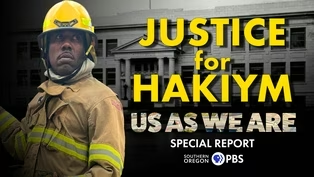
Clip: S6 Ep1 | 1m 24s | Following the "Justice for Hakiym" exoneration movement. (1m 24s)
Providing Support for PBS.org
Learn Moreabout PBS online sponsorship New Episode
- News and Public Affairs

Top journalists deliver compelling original analysis of the hour's headlines.
 New Episode
- News and Public Affairs

Today's top journalists discuss Washington's current political events and public affairs.
 New Episode
 New Episode
 New Episode
 New Episode


 New Episode
 New Episode

Support for PBS provided by:
Us As We Are is a local public television program presented by SOPBS