
June 16, 2026 - PBS News Hour full episode
6/16/2026 | 57m 46sVideo has Closed Captions
June 16, 2026 - PBS News Hour full episode
Tuesday on the News Hour, the questions surrounding the still murky agreement between the U.S. and Iran. As President Trump's Justice Department targets more of his political enemies, former federal attorneys speak out about how this administration has transformed the DOJ. Plus, the U.S. has seen a decline in cancer rates, but diagnoses in Iowa are on the rise.
Problems playing video? | Closed Captioning Feedback
Problems playing video? | Closed Captioning Feedback
Major corporate funding for the PBS News Hour is provided by BDO, BNSF, Consumer Cellular, American Cruise Lines, and Raymond James. Funding for the PBS NewsHour Weekend is provided by...
June 16, 2026 - PBS News Hour full episode
6/16/2026 | 57m 46sVideo has Closed Captions
Tuesday on the News Hour, the questions surrounding the still murky agreement between the U.S. and Iran. As President Trump's Justice Department targets more of his political enemies, former federal attorneys speak out about how this administration has transformed the DOJ. Plus, the U.S. has seen a decline in cancer rates, but diagnoses in Iowa are on the rise.
Problems playing video? | Closed Captioning Feedback
Where to Watch PBS News Hour
PBS News Hour is available to stream on pbs.org and the PBS app.
Providing Support for PBS.org
Learn Moreabout PBS online sponsorshipAMNA NAWAZ: Good evening.
I'm Amna Nawaz.
Geoff Bennett is away.
On the "NewsHour" tonight: Will Israel stop strikes in Lebanon and who controls the Strait of Hormuz?
The questions surrounding the still murky agreement between the U.S.
and Iran.
As President Trump's Justice Department targets more of his political enemies, former federal attorneys speak out about how much this administration has transformed the DOJ.
And the U.S.
has seen a decline in cancer rates, but diagnoses in Iowa are on the rise.
We explore the possible causes and the human toll.
SHELLEY PHELPS, Iowa Resident: You're always waiting for that next shoe to fall.
You know, who's going to be diagnosed next?
(BREAK) AMNA NAWAZ: Welcome to the "News Hour."
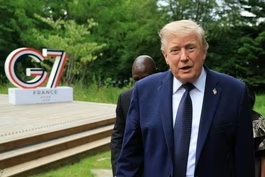
President Trump spent today again meeting leaders of the top industrial nations at the G7 summit in the French Alps.
And he again extolled the framework deal the U.S.
struck with Iran this weekend to start nuclear negotiations and end the war.
But the prevailing question tonight remains, what is actually in that deal?
Days after it was announced, no text has been released publicly.
And complicating matters, Iran is demanding that Israel withdraw its forces from Lebanon as part of the agreement, which Israel says it will not do.
A senior Iranian general said the Revolutionary Guard would strike Israel if it continues attacks in Lebanon.
That's just one of several sticking points that could scuttle any deal.
Our White House correspondent, Liz Landers, begins our coverage.
DONALD TRUMP, President of the United States: The only thing that really matters to me is, Iran will never have a nuclear weapon.
And it says it loud and clear.
LIZ LANDERS: Today, at the G7 summit in Evian, France, President Trump once again hailed the new U.S.
agreement with Iran.
And he claimed once more that the text blocks Iran from ever developing nuclear weapons.
DONALD TRUMP: They're not going to develop it.
They're not going to buy it.
They're not going to do anything with it.
And if they do, they suffer unbelievable consequences.
LIZ LANDERS: But days after the deal was announced, its text has not yet been publicly released, which has led to questions and skepticism from both Trump's critics and even his allies on Capitol Hill.
Mr.
Trump said that, when he releases the text in a couple of days, that he'd leave no room for doubt.
DONALD TRUMP: I will actually -- I will not only release it.
I will probably have a press conference and read it to you word by word, so that the press covers it accurately.
LIZ LANDERS: Swiss officials confirmed more details about the signing itself set to take place at a lavish Alpine resort near Luzern on Friday.
But the beautiful vistas belie the thornier issues at the heart of the deal.
Under the agreement, the U.S.
and Iran would extend their cease-fire and reopen the Strait of Hormuz.
But significant roadblocks remain to ending the war, including the more detailed negotiations about Iran's nuclear program, which the country's top diplomat, Abbas Araghchi, says will start immediately with the U.S.
after Friday's signing.
DONALD TRUMP: You could make the case why you're even bothering, because it's not really valuable.
LIZ LANDERS: But Trump has so far downplayed the urgency for extracting any nuclear material that Iran has.
DONALD TRUMP: We're in no rush, but we get it, and when we get it, we will destroy it.
QUESTION: Is that part of the agreement?
DONALD TRUMP: We're not looking to take it.
We're looking to destroy it.
We have plenty of it.
LIZ LANDERS: What's perhaps more urgent is that Araghchi also said he expected Israel to immediately withdraw its military from Lebanon and end its campaign against Hezbollah as part of the deal, a condition Israel has already rejected.
ABBAS ARAGHCHI, Iranian Foreign Minister (through translator): From our point of view, one side is the United States and Israel.
On the other side is Iran and Hezbollah.
Without the withdrawal of Israeli forces from the territories they occupied during this war, the war has not fully come to an end.
DONALD TRUMP: No, I'm not happy with the way Israel has handled themselves with Lebanon and with Hezbollah.
LIZ LANDERS: Asked today whether Israel could sink the agreement, President Trump said Israeli Prime Minister Benjamin Netanyahu should -- quote -- "be more responsible and consider the bigger implications."
DONALD TRUMP: It just goes on forever.
And when that happens, it throws a negative light on the big deal, and that's the deal with Iran.
LIZ LANDERS: Trump says he suggested to Israel that Syria would be more effective at dealing with a threat from Hezbollah, but Syria's president, Ahmed al-Sharaa, has given no indication he would carry out military operations inside its neighbor's borders.
The Assad regime, both father and son, maintained a 30-year military occupation of Lebanon.
DONALD TRUMP: No, no, it's toll-free, period.
When it opens permanently, it'll be toll-free.
LIZ LANDERS: More disputes over the deal involved a passage through the Strait of Hormuz.
Iran says it plans to charge new fees to ships that enter the strait.
There were, of course, no fees or otherwise charged before the war.
ESMAEIL BAGHAEI, Iranian Foreign Ministry Spokesman (through translator): We have always said we're not after charging tolls, but in exchange for services we will provide, necessary costs will be outlined and received.
So everything is completely clear in this regard.
WHOOPI GOLDBERG, Co-Host, "The View": We are back with Vice President J.D.
Vance.
LIZ LANDERS: Vice President J.D.
Vance has been on a media blitz with more than a half-dozen interviews in just two days, not only to sell the deal, but to clarify what's in it, including a possible $300 billion fund to help rebuild Iran if they cooperate, which both Vance and President Trump insist the U.S.
will not pay for.
J.D.
VANCE, Vice President of the United States: Not a single cent of American money goes to Iran, not $300 billion, not $24 billion, not any of the money, the dollar figures that I have seen floating around.
They don't get any of that stuff unless they totally transform themselves as a country.
And if they do, that's a huge win for everybody, for the region.
If they don't, no skin off our back.
LIZ LANDERS: President Trump remains in France for the G7 through tomorrow, and many of his discussions have been about putting focus back on Ukraine and pressure back on Russia.
Ukrainian President Volodymyr Zelenskyy told reporters that G7 leaders gave their -- quote -- "unanimous support."
And Mr.
Trump himself hinted that the U.S.
could resume oil sanctions against Russia.
But, ultimately, the president downplayed any role that he would play.
DONALD TRUMP: We were focused on Iran.
That will be in the back, in the rearview mirror.
But we will be -- I just -- look, we have nothing to do with it.
We sell weapons to them.
We don't even give them.
Yes, I'm going to do whatever I can.
LIZ LANDERS: For the "PBS News Hour," I'm Liz Landers.
AMNA NAWAZ: For more on what this deal would mean for global shipping and the Strait of Hormuz, I'm joined by Ian Ralby.
He's a global maritime security expert, president of Auxilium Worldwide, and a senior fellow at the Center for Maritime Strategy.
Welcome back to the "News Hour," Ian.
Let's just start with what's happening right now.
President Trump posted earlier today that ships are starting to move out of the Strait of Hormuz.
Does that line up with what you're seeing and hearing?
IAN RALBY, President, Auxilium Worldwide: I'm afraid not.
It has been a very, very slow trickle.
We see about 15 to 20 ships move through a day, often very clandestinely.
And that hasn't really changed.
There's no discernible uptick at this time.
And I think that's probably going to stay the case throughout this week.
AMNA NAWAZ: Well, we just heard Liz report there we have not yet seen the text of this deal between Iran and the U.S.
It's expected to be signed on Friday.
President Trump is already saying that the deal will fully reopen the strait.
Is that reassurance enough for global shipping agencies and insurance companies to bank off?
IAN RALBY: Well, we have heard a lot of very exuberant announcements over the last 3.5 months, most of which have proved not to have a huge amount of content to them.
So I think global shipping can't run on narratives.
It has to run on reality.
And, unfortunately, the reality is still quite uncertain.
And, in fact, the discord between the U.S.
and Iran over what is actually supposed to be in that agreement and what's going to happen vis-a-vis the strait remains very confusing.
The president has announced no tolls.
Iran says, yes, no tolls, but there will be service fees, which sounds like a toll by another name.
So it is very confusing.
And until there's clarity, certainty and consistency over more than just a few hours, the shipping industry is likely to stay put, because we're not talking about some kind of political or wider narrative.
We're talking about people on ships carrying millions of dollars worth of goods.
The catastrophic effect of losing them, both in terms of life and in the environment, is just too much to risk.
AMNA NAWAZ: Say more about those potential tolls, because if the Iranian officials do try to impose some kind of fee or toll, would companies pay that?
I mean, what are they telling you about that?
IAN RALBY: Well, thus far, we have seen some companies willing to pay, because, to be honest, the payment of the toll for the short term seems like a better option than being stuck in the long term.
But there's a couple of problems.
Number one, the Iranians keep saying that they're operating the Persian Gulf Strait Authority, a bureaucratic construct that they have put together to administer not just the toll or fee, as they're now calling it, but some kind of administrative passage requirement, where you either are allowed or not allowed to come through.
And that sort of discretion to discern which ships are and aren't allowed is not at all consistent with the concept of freedom of navigation which governs international straits.
And so this is not only challenging for discerning what to do in this situation, but it sets a potentially dangerous precedent for other parts of the world where we see maritime choke points starting to potentially think along these same terms if Iran is allowed to do this.
International law is very clear, this is not legal, but international law is made by states.
And if states start to agree to this through their flag state responsibilities, as well as through not protesting it, unfortunately, it becomes legal.
And so other places like the Strait of Singapore, Malacca, other critical choke points like the Suez Canal and Panama Canal all become subject to potential increased economic pressures, which would put pressure on everything, not just energy supplies, but all of our goods.
AMNA NAWAZ: There's still so much uncertainty about what's in this deal and how it will unfold.
As we mentioned earlier, Iran's still demanding that Israeli forces leave Lebanon as part of that deal.
How are the shipping sources you're talking to looking at that and how worried are they that this entire deal could fall apart?
IAN RALBY: Very.
I mean, look, we actually really don't have a deal.
What we have is an MOU.
An MOU is a memorandum of understanding, which is inherently nonbinding.
And it was agreed on Monday.
It's supposed to be signed on Friday.
That alone provides a window for all kinds of confusion and potential recrimination, as well as backing away from it.
Even if it's signed as it stands today, there's a 60-day window, from what we can understand, to negotiate the details.
Now, this conflict has been going on for 3.5 months.
Sixty days is a very short period of time, given how difficult it's been to get a nonbinding, pretty basic framework MOU.
So to think that all the nuclear details, the maritime details, are going to be worked out in 60 days without any current visibility as to who the expert technical negotiators will be remains very, very uncertain.
And so I think there's a confidence issue that is building up in the global maritime community, because the president has made lots of bold statements.
Iran's made lots of bold statements.
And, unfortunately, the reality hasn't changed very much since the first week of this war for most of the ships.
They're still in danger.
They're not moving anywhere.
And it's very difficult to discern how to move forward.
And even if the shipping industry feels better, there's still a couple of issues.
The concern around mines is real.
And that will require an overt, above-the-water, very clear, open countermining effort in order to ensure that the strait is clear.
And that will take between three weeks and 60 days.
And so that puts a timeline constant with the actual negotiations before this week, until they're fully confident that the strait would be safe in order to even think of a mass exodus.
But, as you say, the uncertainty is really problematic.
And, unfortunately, shipping needs a great deal of certainty in order to be able to be calmer.
The other side of it is the insurance sector.
And that is unlikely to change any time soon.
AMNA NAWAZ: So, in the minute or so I have left, I feel like I have to ask you this every time we talk as the timelines and the news events shift.
But if there's a deal signed on Friday, and if it then enters the 60-day negotiation period, what are you and others in the industry preparing for in terms of a timeline of when those global trade routes could get back to some kind of normal?
IAN RALBY: Well, if all the variables are taken off the table and everything goes smoothly, which nothing thus far has, we're still looking at, as I said, three to six weeks -- three weeks to 60 days in order to do the countermining operation to make sure the strait is physically safe.
If no attacks occur during that time, and if ships start moving out, we will start seeing an uptick in economic activity.
But, even having said that, it will take several weeks for Qatar to get back up to 80 percent of its capacity on gas and five years to get back to 100 percent.
So we're looking at a long-term time frame before we see the resumption of the full amount of maritime trade that was occurring before this war started on the 28th of February.
AMNA NAWAZ: All right, that is Ian Ralby, president of Auxilium Worldwide.
Ian, thank you so much.
Good to speak with you.
IAN RALBY: Always a pleasure.
AMNA NAWAZ: In the day's other headlines: The Trump administration is taking additional steps to dismantle the Department of Education by moving two high-profile functions out of the agency.
The Justice Department will take over the enforcement of civil rights and education, while the Department of Health and Human Services will oversee special education.
The secretary of education, Linda McMahon, says the changes better align the needs of certain students with the relevant federal agencies.
Critics warn that the changes will undermine efforts to protect students, especially minorities, those with disabilities, and others.
Washington, D.C.
's newly renovated Reflecting Pool is suffering from an old problem, algae.
National Park Service workers were seen this morning dumping hydrogen peroxide to combat the issue.
Observers have noted that the famous pool looks rather green, as opposed to the American flag blue that President Trump had promised.
The $14 million project is part of a cleanup effort of the nation's capital, as the country marks 250 years of independents.
Some visitors have questioned whether keeping the pool blue is realistic.
PATRICK HICKS, Florida Resident: I think it's an impossible task to actually expect that to be blue and stay blue.
I don't think you can fight Mother Nature.
And the nature of this pool, any time you have an environment that big, that's like cleaning a lake.
AMNA NAWAZ: The Interior Department has claimed in recent days that a new water treatment system would help address the algae problem.
A spokesperson has been quoted as saying -- quote -- "The algae is dead and being vacuumed up as we speak."
In California, crews are making progress to contain a wildfire that broke out yesterday in the greater Los Angeles area.
Closures were lifted this morning on a nearby freeway seen here behind a haze of smoke.
It was shut down when the Shore Fire quickly expanded to more than 2,000 acres overnight, leading to evacuation orders that are largely still in place.
As of this afternoon, the blaze was 25 percent contained and no injuries have been reported.
The cause is under investigation.
British officials are investigating reports that a Russian warship fired warning shots at a U.K.-registered civilian yacht in the English Channel today.
The incident occurred around 20 nautical miles south of the Isle of Wight outside of U.K.
territorial waters.
Russia's Defense Ministry says the commanding officer of the ship called the Admiral Grigorovich ordered the shots because the yacht was heading on what officials called a dangerous collision course toward the warship.
No damage or injuries have been reported, but the incident comes at a time of heightened tensions between the two countries.
Health officials in Africa are warning that the Ebola outbreak in the Democratic Republic of the Congo could become the worst that Africa has ever seen.
The head of Africa CDC says that tens of thousands of people who may have had contact with sick patients are not being monitored, raising concerns about a further spread of the disease.
An official at the Red Cross adds that while response efforts have improved, the lack of testing has complicated the situation.
BRUNO MICHON, International Red Cross: The response has been more and more efficient, but, yes, the peak is I think not behind us, but in front of us.
AMNA NAWAZ: Meantime, DRC health authorities said today that there are now more than 830 confirmed cases, including at least 196 deaths.
The outbreak is already one of the deadliest ever recorded in the country, and experts say it could be months before a vaccine is available.
Turning now to the World Cup and the cross-section of sports and politics, at the G7 summit in France today, German Chancellor Friedrich Merz gifted President Donald Trump a German soccer jersey.
It features the number 47 in honor of Trump being the 47th U.S.
president.
Merz posted images of the exchange on social media, wishing President Trump a happy belated 80th birthday and adding: "After all, we're on the same team."
Separately, Iran's coach has called his squad -- quote -- "perhaps the most oppressed team at the tournament" after they were forced to leave the U.S.
soon after last night's 2-2 draw with New Zealand.
As for today's action, France shook off an uneasy start to beat Senegal by three goals to one.
Venus and Serena Williams will reunite on the court at Wimbledon later this month as a wild card entry in the women's doubles competition; 44-year-old Serena, and Venus, who turns 46 tomorrow, last played together at Wimbledon in 2016, when they won their sixth doubles title at the event.
The announcement of their return comes just a week after Serena's first official match in nearly four years.
Neither Williams sister is slated to play singles at Wimbledon, but it's not entirely impossible, with one wild card spot yet to be announced.
In the business world, Pizza Hut's parent company is selling off the struggling chain for $2.7 billion.
Yum!
Brands said today its main business will be bought by private equity firm LongRange Capital, while Yum China will buy up its mainland China operation.
Pizza Hut has struggled against rising competition from the likes of DoorDash and Uber Eats.
Shares of Yum!
Brands closed the day nearly 2 percent higher.
Meantime on Wall Street, stocks ended mixed after Monday's rally.
The Dow Jones industrial average gained more than 300 points, but the Nasdaq loss ground, falling 300 points, or more than 1 percent.
The S&P 500 also closed in negative territory.
Still to come, on the "News Hour": we travel.
to one of the only states in the U.S.
where cancer rates are rising; Anthropic works to quiet the White House's security concerns over its powerful A.I.
models; and a new center looks at the impact of slavery and ways to expand the idea of freedom today.
Justice Department officials appointed by President Donald Trump have made sweeping changes since he returned to office.
They redefined the focus of key divisions and challenged legal norms.
And thousands of career lawyers have resigned or been fired.
Former Justice Department officials say those changes are transforming not only what the department does, but what its leaders expect from its employees.
Justice correspondent Ali Rogin asked several former DOJ attorneys and leaders to reflect on what they have seen and what they believe it means for the future of the institution.
KYLE BOYNTON, Former Federal Prosecutor: My name is Kyle Boynton.
Prior to leaving the DOJ, I was a prosecutor with the Criminal Section of the Civil Rights Division.
I started my career with the Justice Department in 2010 as a special agent with the Federal Bureau of Investigation.
ANAM PETIT, Former Immigration Judge: My name is Anam Petit.
I was an immigration judge within the Department of Justice prior to my termination in September 2025.
BRENDAN BALLOU, Former Federal Prosecutor: My name is Brendan Ballou.
I'm a former special counsel in the Antitrust Division of the Justice Department.
SEAN MURPHY, Former Federal Prosecutor: My name is Sean P. Murphy.
I'm a former assistant United States attorney.
I most recently worked with the U.S.
attorney's office for the District of Puerto Rico, but I work on a detail with the Capitol siege section out of the U.S.
attorney's office for the District of Columbia.
KYLE BOYNTON: The Justice Department has long been a place and had a tradition of being apolitical in its approach to things.
And I was increasingly seeing decisions being made within the Civil Rights Division for political reasons.
And that troubled me.
BRENDAN BALLOU: I left because I had spent two years prosecuting January 6 rioters.
On the very first day of Donald Trump's second term, he issued a pardon for over 1,500 people who were accused of attacking the Capitol that day and the people inside.
So it was obvious to me that Donald Trump was going to try to use the Department of Justice to enact vengeance, to enact violence against those who opposed him.
And I thought that I could do more good on the outside than I could on the inside.
SEAN MURPHY: I decided that I needed to leave the Department of Justice because I saw the writing on the wall.
There came a time shortly after Pam Bondi's confirmation as attorney general of the United States that she sent out a series of memos.
One of those memos in particular said that, as AUSAs, we were expected to be the president's lawyers and do whatever he asked of us.
And failure to do so would be to deprive the president of his attorneys.
That didn't sit well with me then.
It doesn't sit well with me now.
BRENDAN BALLOU: The harm that this administration is doing to the Department of Justice and the rule of law generally in America is generational.
It is going to take decades to recover from the damage that they have caused.
ANAM PETIT: We have seen this administration hire many new deportation judges, as they're calling them, instead of immigration judges, to fill the role for the many, many immigration judges who they have since fired.
And I am very concerned about the quality of these candidates.
KYLE BOYNTON: We are dealing with extremists who are making decisions that the Justice Department should act on ideologies, should act in the interest of particular ideological beliefs.
And I think that is what is so dangerous about this moment is this extremist view that you're not holding a position of public trust, but you are actually a political actor who is supposed to be using the Justice Department for political reasons.
ANAM PETIT: I'm very worried that we're not going to be able to attract the same level of talent that the Department of Justice has historically been able to attract.
I'm also really worried about the lack of trust that we're getting from our constituents, from the taxpayers, from the American people, that we're just not viewed with that neutrality and as that pinnacle of fairness anymore, because we're just marred by politics.
SEAN MURPHY: I don't know if you can legislate your way out of the degradation of the rule of law.
We will have to have people in charge who respect that separation between the president and the attorney general and allow the U.S.
attorneys around the country and the Justice Department in general to pursue justice without fear or favor.
BRENDAN BALLOU: The vast majority of folks in the Department of Justice, I continue to believe, are trying to do the right thing, but it is going to be an enormous challenge to undo the damage to the soul of the Department of Justice.
And I think, for that reason, a lot of folks who would return to DOJ without question this time around might not.
AMNA NAWAZ: And Ali Rogin joins us now for more.
Ali, want to pick up on the concern we heard there about the DOJ being able to continue to attract top talent.
You have been looking into this.
And what have you found?
ALI ROGIN: I have been speaking with law students over the past few days from all over the country on the condition of anonymity so that they can speak freely.
And what I have been hearing from many of them is that they would be interested in working for the Department of Justice over a president from either party, but not this Department of Justice.
Several said they could not defend some of the policies that this White House and the Department of Justice have been asking attorneys to defend.
Many of them cited holding immigrants and deporting undocumented immigrants without due process.
This is what one recent law school graduate told me.
He had actually been planning to apply to the Department of Justice until up until a year ago.
He said -- quote -- "There have been many actions by the DOJ that have significantly tainted its reputation.
And I am not willing to risk any harm to my reputation or be in a position where I may be asked to do something I know is wrong."
Another student from a relatively conservative law school told me that she wouldn't want to be associated with what she called a poor work product coming out of the Department of Justice.
Recently, she shared an example with me of a filing that looks, frankly, more like a TRUTH Social post than it does an official legal document.
It has random words capitalized like President Trump likes to do in his posts and references to "Trump Derangement Syndrome."
Now, Amna, I should point out this -- I did not go out and conduct a poll, so I really can't make any sweeping conclusions here.
But what I did hear is a better sense of how some students who would have otherwise applied to work at the DOJ are thinking about public service now.
AMNA NAWAZ: And for the students who are still planning to apply to work for the DOJ, what are they telling?
ALI ROGIN: Yes, I heard from many of them as well.
And some of them said they felt that they still had a duty to serve.
One told me that criminals still need to be prosecuted.
Another said he saw the recruiting crisis at the DOJ as an opportunity, because they have begun accepting lawyers strait out of law school, when previously they did not do that.
Several also told me that they were interested in working for the DOJ,but at a state U.S.
attorney's office outside of Washington, and therefore they hope insulated from some of the politics.
I heard from one student at a Midwest law school who is currently interning in a U.S.
attorneys office.
He told me -- quote -- "I have found everybody in this office to be professional and nonpolitical.
Regardless of what may be going on in D.C., I find the work I'm doing to be important, fulfilling and non-controversial."
AMNA NAWAZ: Of course, as all of your reporting, you have gone to DOJ for comment on all of this.
What do they say to you?
ALI ROGIN: Yes.
Of the former Department of Justice officials that I spoke to and what they said, a spokesperson said -- quote -- "It should come as no surprise that those who took part in Biden's weaponization of DOJ would claim that righting those wrongs is, ironically, weaponization" and that "those who were fired were fired for a reason."
The spokesperson also said that the DOJ has been able to achieve policy victories without the supposed -- quote -- "exodus of anti-Trump prosecutors the media idolized," although it's been well reported that the number of attorneys leading leaving the DOJ and the rest of the federal government is outpacing new hires.
And on the question of what law students are doing, this spokesperson noted that there have been many new lawyers that have joined the Department of Justice and added -- quote -- "We look forward to welcoming many more lawyers, including young attorneys, who understand our constitutional system, where DOJ is accountable to the executive branch."
AMNA NAWAZ: All right, switching gears now a little bit, I want to turn to some news today about a foiled plot to attack the Ultimate Fighting Championship event that took place at the White House this weekend.
What do we know about that?
ALI ROGIN: That's right.
This morning, FBI Director Kash Patel posted on X that a plot was -- quote -- "stopped cold by the FBI and law enforcement partners" and that multiple individuals are now in custody.
According to an arrest document, one of the individuals is a 19-year-old Ohio man named Tycen Proper who said he had been planning an attack with a group of political extremists.
Proper's mother is the one that had called law enforcement to flag his behavior.
He'd been communicating with individuals who she said seemed to have ultrareligious and anti-government views and that he had purchased firearms.
This group had been planning to fly drones laden with explosives over the event and then fire at people in the dispersing crowd after the explosives had detonated.
So far, Amna, we know that five individuals have been arrested.
AMNA NAWAZ: So, five individuals were that -- was that the entire group planning this attack?
Or could there be more people at large?
ALI ROGIN: There could be more people at large.
There have been reports today that there are up to 23 people who were involved.
In any event, FBI Director Patel's counterparts in other federal law enforcement agencies have criticized his disclosure of this investigation at such an early stage.
The deputy director of the U.S.
Secret Service today told reporters that revealing the active investigation as it's ongoing could really undermine its integrity.
He said that the fight attendees were never in harm's way, but that talking about it, this kind of multistate probe at this early stage, is premature.
And he had an admonishment that seemed directed at Patel.
MATTHEW QUINN, Secret Service Deputy Director: Don't choke on your own smoke.
Anyone that believes that case was worked in a bubble is naive.
I will tell you, the Secret Service led that investigation from the beginning.
I will tell you that it's ongoing.
In order to maintain the integrity of the investigation and the security plan, we chose not to leak it.
ALI ROGIN: Just to underscore, that's the number two at the Secret Service accusing the FBI director of a leak that could endanger an ongoing investigation, Amna.
AMNA NAWAZ: Worth underscoring.
Justice correspondent Ali Rogin, terrific reporting.
Thank you.
ALI ROGIN: You bet.
AMNA NAWAZ: For years, national conversations about cancer often focused on the so-called Cancer Alley in the Deep South or Appalachian states with high smoking rates.
But, recently, a different state has grabbed headlines.
Iowa.
It now has the second highest cancer incidence in the country, and is one of only three states where rates are rising.
Special correspondent Fred de Sam Lazaro went to Iowa and has this report on the search for answers.
FRED DE SAM LAZARO: For 35-year-old Becca Mataloni, it started in 2019 with a crackling noise every time she inhaled.
BECCA MATALONI, Iowa Resident: Kind of like dial-up Internet, is how I always describe what it sounded like.
FRED DE SAM LAZARO: In 2022, she developed pneumonia, in 2024, another bout of pneumonia.
Mataloni, who lives in the Des Moines area, had multiple scans and met with a pulmonologist, who delivered the diagnosis, a cancerous tumor on her lung.
BECCA MATALONI: It's really devastating to get a cancer diagnosis in your 30s.
And even though my pulmonologist told me that I was going to be OK, it sucks, and hearing I'm going to lose two-thirds of my lung.
Like, one of the first questions I asked was, am I still going to be able to do the things I love?
FRED DE SAM LAZARO: In rural Northern Iowa, Shelley Phelps lost her sister to breast cancer in 2015.
Two years later, her husband, Michael, was diagnosed with stage four colon cancer.
SHELLEY PHELPS, Iowa Resident: You think, how can I go through this again?
And how can my kids go through this again?
FRED DE SAM LAZARO: They had to drive at least an hour any time Michael needed treatment.
In 2020, he died at the age of 50.
SHELLEY PHELPS: I have always said that, if it wasn't for my faith, I would not have gotten through this, because you're always waiting for that next shoe to fall.
Who's going to be diagnosed next?
FRED DE SAM LAZARO: The stories represent a grim reality for Iowa, which was following national cancer trends until about 2013, when rates began to rise, driven by prostate, breast and lung cancer, as well as melanoma.
Now, for the third year in a row, it's got the second highest cancer incidence in the country.
Its rate among young people is also near the top.
As Iowa's high cancer rates have persisted in recent years, there's been growing public concern, with key unanswered questions.
What's to blame for them and what are state officials doing about it?
MARY CHARLTON, Iowa Cancer Registry: As much as we would love to reduce it down to one thing and figure this out and change Iowa's rates, we would do that.
But that's not how cancer works.
FRED DE SAM LAZARO: Mary Charlton leads the Iowa Cancer Registry, which has tracked the state's cancer data for over 50 years.
Charlton and her staff have been traveling Iowa's 99 counties, meeting with residents.
MARY CHARLTON: A lot of people that come to the meetings have had cancer, had a loved one diagnosed with cancer, and they want to know why.
That's a really maddening thing about cancer too is, people can be exposed to the same things and their immune system might process them differently.
It's not an excuse to not try to figure out what's causing the cancer and do something about it, but it kind of explains why it's kind of a slow slog to figure out what's causing our rates to be higher than the rest of the country.
FRED DE SAM LAZARO: Charlton does talk about some potential culprits and solutions.
Iowa has among the nation's worst binge-drinking rates.
It hasn't raised its cigarette tax, proven to reduce smoking, in almost 20 years.
And the entire state is labeled high risk for radon, a radioactive gas found naturally in the earth that can seep into homes and cause lung cancer.
Adam Shriver is the director of wellness and nutrition policy at The Harkin Institute of Drake University in Des Moines.
ADAM SHRIVER, The Harkin Institute, Drake University: We felt like a lot of the discussions in the state had been focusing on behavioral factors and genetic factors, but there was sort of this big elephant in the room in Iowa, which is the fact that we are one of the most intensively farmed states in the country.
FRED DE SAM LAZARO: Agriculture accounts for over 80 percent of Iowa's total land.
The state produces more corn, eggs, and pork than anywhere else in the country.
In March, Shriver and a team of researchers released a report that showed links between Iowa's most common cancers and certain environmental risk factors like pesticide use and nitrate run-off from fertilizers.
Dan Voss is a fifth-generation corn and soybean farmer near Cedar Rapids.
In 2012, Voss' wife, Susan, was having a routine checkup when doctors found a mass in her abdomen.
It was liver cancer.
She underwent treatment and surgery and is now cancer-free.
In 2024, after experiencing some issues with his hands, Dan was diagnosed with non-Hodgkin's lymphoma.
He's currently undergoing maintenance chemotherapy.
Have you wrestled with the mystery of what -- you know, what got you here?
DAN VOSS, Iowa Farmer: Well in my case, could it be ag?
Well, I think there's a chance.
Can I say it is with 100 percent certainty?
No.
I think the state needs to have a good honest discussion about where we're at, what we can do.
There are some things we can do on the ag side that would probably help.
FRED DE SAM LAZARO: For years, Voss has used farming techniques that reduce the amount of nitrates in the water.
DAN VOSS: Just because you talk about it, that's not an indictment of agriculture.
ADAM SHRIVER: I would definitely argue that, right now, public health is not part of the equation when we're deciding on agricultural policy.
And it seems like it really should be.
FRED DE SAM LAZARO: You are convinced that the fertilizers that you use today and the insecticides are safe if applied as directed on the label?
STEVE KUIPER, Vice President, Iowa Corn Growers Association: Yes.
FRED DE SAM LAZARO: Steve Kuiper is vice president of the Iowa Corn Growers Association, a major industry group in the state.
STEVE KUIPER: Too many people are poking farmers in the chest and saying, you're polluting, you're polluting, you're polluting.
Farmers are more than willing to make changes and make adjustments to their operations, but they need some data to support that.
A lot of products have gone -- had years and years of testing before they ever went to market.
So then, all of a sudden, everybody's like, well, this has got to be the problem.
FRED DE SAM LAZARO: Iowa Corn has joined a coalition mostly made up of health organizations working to solve the state's cancer crisis.
DR.
DANIEL KOLLMORGEN, Mahaska Health: When a patient comes to see me with a new cancer, they typically aren't asking about, why are the cancer rates in Iowa so high?
They're asking about, what do I do for mine.
It does pick up stuff.
FRED DE SAM LAZARO: Daniel Kollmorgen is the medical director of oncology at Mahaska Health in Oskaloosa, a city of about 12,000 about an hour east of Des Moines.
DR.
DANIEL KOLLMORGEN: Oftentimes, in a rural location, there can be delay from onset of symptoms to accessibility of diagnosis, getting a biopsy, getting scheduled.
I try to move them off the bubble of not knowing what's going on, I have a cancer and I'm going crazy, but they don't know what comes next, and to reassure them that there is treatment, that there's a pathway forward.
FRED DE SAM LAZARO: Although the incidence of cancer in Iowa is high, mortality rates so far are in line with the rest of the country.
It's one reason Kollmorgen says he'd like to see better cancer screening in rural areas, but also tighter regulation of farm chemicals and more water quality monitoring.
ZACH LAHN (R), Iowa Gubernatorial Candidate: It's about stopping the cancer crisis that is plaguing our state.
FRED DE SAM LAZARO: In November, Iowans will vote for a governor, U.S.
senator and agriculture secretary.
Tackling the state's cancer problem has already come up repeatedly on the campaign trail.
And while many residents want more action from lawmakers, people like Shelley Phelps are filling in the gaps where they can.
She's part of a foundation that's helped over 700 people in her county dealing with cancer.
More requests come every week.
For the "PBS News Hour," I'm Fred de Sam Lazaro in Iowa.
AMNA NAWAZ: The Trump administration has forced Anthropic, one of the country's leading artificial intelligence companies, to disable its newest and most powerful A.I.
models, citing, the company says, unspecified national security concerns.
It's an unprecedented move that comes as the federal government struggles to define the guardrails for an industry whose technology is advancing at a rapid pace.
Stephanie Sy has more.
STEPHANIE SY: Amna, Anthropic has reportedly been in talks with the Trump administration since the weekend, trying to restore access to users of its latest A.I.
models.
On Friday, Amazon CEO Andy Jassy raised concerns, telling White House officials that researchers had found a way to get through the model Fable 5's guardrails, posing a cybersecurity risk.
The president agreed, and his team abruptly slapped foreign export restrictions on the company.
Anthropic said the only way for it to comply was to cut off access to all its users of Fable 5 and the even more advanced Mythos 5, billed as some of the most powerful A.I.
tools available on the market.
For more, we're joined now by Amrith Ramkumar, tech policy reporter for The Wall Street Journal, who has been covering this all closely.
This is a tremendous clash, an A.I.
company that was recently valued at almost $1 trillion facing off against the Trump administration.
What led to such a drastic action by the White House over the weekend?
AMRITH RAMKUMAR, The Wall Street Journal: It is truly remarkable.
This is the first time that we know about that the government has essentially told the leading A.I.
company that its models aren't safe for public consumption and need to be shut off.
And the concern specifically among administration officials is that users could enter prompts into this model of Fable 5 specifically that could get around safeguards that were designed to avoid cyberattacks, bioweapons, and other bad things.
So we don't know a ton of specifics because they haven't released much about what exactly the Amazon folks found that was so alarming.
But the fact that there was this concern alarmed people in the White House, and they took the drastic action very quickly.
STEPHANIE SY: Anthropic is defending itself by saying there are other models, including some open-source models, that can do the same thing that the Amazon researchers found Fable 5 can do.
As you said, we don't know the details.
But is that true based on what experts in the sphere are saying?
AMRITH RAMKUMAR: A lot of cybersecurity experts who have seen the report have said that other models are capable of doing some more things and that government steps here were an overreaction.
It's also very important to point out that the U.S.
government and Anthropic have been fighting for many months now.
A few months ago, they had a huge spat over how A.I.
is used in the Pentagon and the guardrails there that led to the Defense Department classifying Anthropic as a supply chain risk, a huge security risk, and that led to multiple lawsuits.
So the big question here that a lot of people are asking is, is this about Anthropic versus the U.S.
government or is this about all U.S.
A.I.
models that are at the frontier space?
STEPHANIE SY: The Commerce Department's move to restrict access has prompted backlash within the A.I.
industry.
Dozens of prominent researchers and tech workers signed an open letter, saying: "This action has taken the best models away from defenders, created market uncertainty and risked America's A.I.
leadership without any real risk to justify it."
So that's what the industry is saying.
The U.S.
government is not only an Anthropic customer - - you mentioned the Department of Defense -- but potentially a future shareholder.
And it's now shown it can shut down an A.I.
company's arguably best product in a matter of hours.
What are the worries you're hearing from inside the industry about this move?
AMRITH RAMKUMAR: People in the industry have been fretting for weeks now that the government has totally changed their stance on A.I.
regulation.
For a long time, the Trump administration had deployed a laissez-faire approach to the space.
It was sort of industry-friendly.
We don't want to lose the A.I.
race to China.
We generally like what the companies are doing and we'll work alongside them.
The release of Mythos from Anthropic earlier this year changed all of those conversations.
Now President Trump has signed an executive order a couple of weeks ago where national security officials and cybersecurity officials will play a much bigger role in looking at models before they are released and evaluating cyber threats.
And that's exactly what happened here essentially is, national security and cybersecurity experts within the government, along with others, grew alarmed that there could be potential harm here, and, like you said, they took down the model.
STEPHANIE SY: Amrith, there's a lot of anxiety about the power of these companies and this rapidly evolving technology.
What does this move by the Trump administration say about how the technology might be governed in the future?
AMRITH RAMKUMAR: This shows that the government is going to be much more involved in A.I.
governance going forward.
That's the bottom line.
Regardless if you talk to Trump administration officials, Democrats and Republicans on the Hill, researchers, they all say these latest models are no joke.
They're capable of cyberattacks.
They could be capable of biological weapons and all kinds of other stuff without the right guardrails.
So the sort of hands-off, head-in-the-clouds approach that might have been on the table a few months ago or at the start of the year or last year, that's sort of gone.
And what a lot of people are focused on is that Chinese companies and the Chinese government likely have access to some more tools, or they will very soon.
So that's really big part of all of this debate as well.
STEPHANIE SY: And something they will have to balance.
That is Amrith Ramkumar, tech policy reporter at The Wall Street Journal.
Thank you so much.
AMRITH RAMKUMAR: Thank you so much for having me.
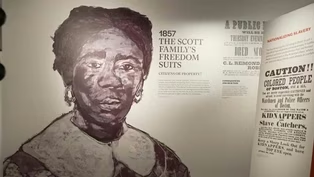
AMNA NAWAZ: The Shockoe Institute in Richmond, Virginia, opened its doors this spring to try to open minds about the enduring impact of enslavement and how to seek solutions to improve civic life now.
I took a look at the effort for our series Art in Action at the intersection of arts and democracy, part of our Canvas coverage.
A Tuesday summer afternoon and another student tour through American history.
WOMAN: So I never use the term slave.
What term do I use, those of you who know me?
A what?
An enslaved person.
AMNA NAWAZ: Like other institutions, this one tells the story of America's system of slavery.
But 17-year-old Alana Newton and 14-year-old Tatiana Porter say this exhibit called Expanding Freedom goes further than what they learned in school.
ALANA NEWTON, Girls For a Change: You can physically feel how severe and how textbooks taught in school will try to sugarcoat it and lessen the severity.
TATIANA PORTER, Girls For a Change: Some people are not taking into consideration of what our ancestors did for us.
Walking through this exhibit really opened up my mind to different perspectives.
AMNA NAWAZ: That link from the past to the present is central to the Shockoe Institute, located in Richmond, the former capital of the Confederacy and once the largest trading market for enslaved people in the upper South.
MARLAND BUCKNER, President and CEO, Shockoe Institute: People are generally unaware of the sheer size of the domestic slave trade.
AMNA NAWAZ: Marland Buckner is president and CEO.
MARLAND BUCKNER: Nearly one million enslaved Americans were moved from the upper South to the lower South, forcibly removed, in many instances forced to march 1,000 miles.
It's 1,000 miles from Richmond to Natchez, 1,000 miles, the equivalent of one 747 jet per week.
The first half of the 19th century, is an extraordinary time of deprivation and of tyranny.
And that is not a story that many Americans are really conversant in at all.
AMNA NAWAZ: The institute was born of an 11 million dollar grant from the Mellon Foundation.
For the record, the foundation is also a funder of the "News Hour."
Buckner and his team say they aim to focus on the humanity of the individual, turning those numbers into names and details, all faces and portraits displayed at eye level, look-throughs in the walls, showing how stories and events in one moment are connected to another, and a life-size video depicting the forced March from Richmond to Natchez, Mississippi, featuring this young boy, who turns to make eye contact with visitors.
You say museum-like.
What does that mean?
MARLAND BUCKNER: We're not a collecting institution.
We don't collect anything.
What we are is a place of learning, reflection and, most importantly, of action.
It's our hope that what we will do through the exhibit experience is give visitors the opportunity to ask questions about where things are today, where things should be today, and how we can work together to use the lessons of our history to improve our civic life to make a better tomorrow.
AMNA NAWAZ: The 10,000-square-foot institute sits within the old Main Street train station in Richmond's Shockoe Bottom neighborhood.
MARLAND BUCKNER: When you think about the movement of people, of capital, and of cotton, our visitors are generally very surprised to learn of the financial sophistication that was a part of this system.
People think about enslaved people as being bought and sold in markets.
Yes, that happened.
But enslaved Americans were mortgaged, they were rented, they were insured.
AMNA NAWAZ: Hundreds of thousands of enslaved Black people were bought, sold and trafficked from this district, which houses the infamous Goodwin Slave Jail, where Solomon Northup was held after being kidnapped from Washington, D.C., as documented in his 1853 memoir "Twelve Years a Slave"... ACTOR: Come back here, boy.
AMNA NAWAZ: ... which inspired the 2013 film by the same name.
Senior consulting historian Greg Kimball says the economic through line is integral to understanding how American history informs its future.
GREGG KIMBALL, Senior Consulting Historian, Shockoe Institute: We're just going about our lives.
We have systems that we think are just predestined to be.
But people made decisions that African enslaved people would be the core of our economic system.
And so what decisions are we making today?
How are we going to perfect that liberty that Jefferson talked about?
To me, that's the story of America.
AMNA NAWAZ: Aesthetically, that translates to visitors walking across a carpet that maps out with orange dots locations of the dozens of businesses built around the slave trade in town,angled walls in one section on the Reconstruction era to invoke the feeling of pressure and limitations of the time, and displays that reveal central facts to Virginia's specific role in shaping America's system of slavery and the economy around it.
The 1705, for example, I step into the light.
MARLAND BUCKNER: 1705 is exactly when Virginia lawmakers decided that slavery would be based on race.
AMNA NAWAZ: Explicitly tying it to race.
MARLAND BUCKNER: Precisely.
AMNA NAWAZ: And Virginia was the first to do that.
MARLAND BUCKNER: Virginia was the first to do it.
And we're still fighting that today.
AMNA NAWAZ: L'Rai Arthur-Mensah has worked on exhibits around the world before joining the Shockoe Institute.
L'RAI ARTHUR-MENSAH, Director of Local Projects, Shockoe Institute: This was where all the chaos was ensuing with the Civil War.
We needed to select specific elements to make sure that people understood that decisions made at this point in time actually impact decisions that were made down the line 100 years or 200 years later.
AMNA NAWAZ: Concluding the hour-long experience is The Lab, a gathering place where visitors like Alana, Tatiana and their group talk through what they have seen and tackle questions like what they can do now.
GIRL: Why would they treat others like that if they wanted to be more like God?
WOMAN: That's a really valid question.
And let's just be clear, it's not an altruism.
Not every white person felt this way.
And it's also an altruism that not every Black person also felt oppressed.
The system of enslavement could never function without some form of collaboration.
MARLAND BUCKNER: It's often said that the United States is the world's longest functioning democracy.
But I am one of the first generation to be born into the United States as a fully functioning multiracial democracy.
Our democracy is actually very young.
And when you understand that point, you can begin to see the enduring impact of racial slavery.
AMNA NAWAZ: Do you think there was something for you personally being part of that generation knowing your place in the American story, American history that said you have to do this?
MARLAND BUCKNER: Deep down, probably more than I realized.
My grandfather sat on his grandfather's knee.
That man was born enslaved.
I sat on my grandfather's knee.
When you think of these questions as abstractions, that's what they become.
When you put them in human terms, they look much different.
AMNA NAWAZ: Later this year, the institute is taking its mission outside of Richmond, a New Orleans symposium with artists, activists and scholars on the impact of Confederate monument removals, and another program called Unfinished Business streaming nationally this fall.
Finally tonight, a PBS programming note.
A film tracing the rise of legendary newspaper publisher Katharine Graham, from a shy socialite to Nixon nemesis to Pulitzer Prize winner, that premieres this evening on PBS at 9:00 p.m.
Eastern.
Remember, there's always a lot more online, including a report about music that's spreading derogatory ideas about Muslims in India.
You can read about how those songs are spreading on some of the largest music platforms.
That's at PBS.org/NewsHour.
And that is the "News Hour" for tonight.
I'm Amna Nawaz.
On behalf of the entire "News Hour" team, thank you for joining us.

Anthropic disables AI model after U.S. security directive
Video has Closed Captions
Anthropic disables new AI model after White House security directive (5m 59s)

DOJ: 5 arrested over plot to attack White House UFC event
Video has Closed Captions
5 arrested over plot to attack White House UFC event, DOJ says (2m 25s)
Ex-officials reflect on Trump's transformation of DOJ
Video has Closed Captions
Ex-DOJ officials reflect on Trump's transformation of the institution (8m 23s)

Iowa sees a troubling rise in cancer diagnoses
Video has Closed Captions
As cancer rates fall nationally, Iowa sees a troubling rise in diagnoses (8m 19s)

Maritime security expert weighs U.S.-Iran deal's impact
Video has Closed Captions
Maritime security expert weighs U.S.-Iran deal's impact on global shipping (7m)

News Wrap: Key oversight shifted from Education Department
Video has Closed Captions
News Wrap: Civil rights, special education oversight shifted from Department of Education (6m 16s)
Questions linger over U.S.-Iran deal as details remain murky
Video has Closed Captions
Questions linger over U.S.-Iran deal as details remain murky (5m 53s)
Shockoe Institute explores enduring impact of slavery
Video has Closed Captions
Shockoe Institute explores enduring impact of slavery and how to expand freedom today (7m 38s)
Providing Support for PBS.org
Learn Moreabout PBS online sponsorship
- News and Public Affairs

Today's top journalists discuss Washington's current political events and public affairs.

- News and Public Affairs

FRONTLINE is investigative journalism that questions, explains and changes our world.


 New Episode
 New Episode
 New Episode




 New Episode
Support for PBS provided by:
Major corporate funding for the PBS News Hour is provided by BDO, BNSF, Consumer Cellular, American Cruise Lines, and Raymond James. Funding for the PBS NewsHour Weekend is provided by...