
Trump's response to Supreme Court rulings and what's next
Clip: 6/30/2026 | 6m 24sVideo has Closed Captions
Trump's response to the landmark Supreme Court rulings and what's next
To discuss how the Trump White House responded to Tuesday's rulings and the relationship between the president and the Supreme Court, Geoff Bennett spoke with White House correspondent Liz Landers and Supreme Court analyst and SCOTUSblog co-founder Amy Howe.
Problems playing video? | Closed Captioning Feedback
Problems playing video? | Closed Captioning Feedback
Major corporate funding for the PBS News Hour is provided by BDO, BNSF, Consumer Cellular, American Cruise Lines, and Raymond James. Funding for the PBS NewsHour Weekend is provided by...
Trump's response to Supreme Court rulings and what's next
Clip: 6/30/2026 | 6m 24sVideo has Closed Captions
To discuss how the Trump White House responded to Tuesday's rulings and the relationship between the president and the Supreme Court, Geoff Bennett spoke with White House correspondent Liz Landers and Supreme Court analyst and SCOTUSblog co-founder Amy Howe.
Problems playing video? | Closed Captioning Feedback
Where to Watch PBS News Hour
PBS News Hour is available to stream on pbs.org and the PBS app.
Providing Support for PBS.org
Learn Moreabout PBS online sponsorshipGEOFF BENNETT: And for more now on how the White House has responded to today's rulings and the relationship between the president and the nation's highest court, we are joined again by Amy Howe and our White House correspondent, Liz Landers.
So, Liz, as you well know, President Trump was personally invested in this birthright citizenship case.
He even attended the oral arguments, which is rare for sitting presidents.
I don't think it's -- well, it might have happened before, but not in modern history.
LIZ LANDERS: Yes.
GEOFF BENNETT: How is he responding to today's ruling?
LIZ LANDERS: He's responding with disappointment.
The only thing we have heard from him so far is this TRUTH Social post that he posted this morning.
And I know you all read that earlier, but in it he talks about the future and what he may be able to do going forward and a pathway he thinks to still overturning birthright citizenship.
He wrote out that Congress should start today to work on ending this.
And he posted earlier in the morning, actually right before this decision came out from the Supreme Court, a post from a Web site called Just The News, and the headline says -- quote -- "Trump's efforts to reverse birthright citizenship may succeed with or without the Supreme Court."
And this story suggests that Congress could change the law with legislation called the Birthright Citizenship Act.
This was introduced by two allies of the president, Senator Lindsey Graham and another House Republican, on the day that he was inaugurated in January of 2025.
And this piece of legislation would amend the Immigration and Nationality Act.
I think we are probably going to see the president push members on this, but it is unclear how that would fare, given today's very definitive decision from the Supreme Court.
There are other allies of the presidents on Capitol Hill, like Senator Mike Lee, who was acknowledging that this sort of change would require an actual constitutional amendment.
And, more broadly though, Geoff, I think that this is an interesting moment, when we're seeing the president increasingly react and lash out at the Supreme Court.
Back in February, I was in the Briefing Room when the tariffs decision came down and the president had a press conference, and he was very angry and upset with the Supreme Court justices, in particular, some of the justices that he had appointed to the court that ruled against him in that decision.
There were more justices today who he had appointed to the court who also ruled against him in the citizenship case.
GEOFF BENNETT: On this matter of birthright citizenship, how has the president's argument, how has it evolved over the years, and what does it mean now for his immigration agenda?
LIZ LANDERS: Honestly, the president has been saying the same thing about this since he announced his presidency, his presidential bid in 2015.
I was looking back at some of his comments from that time, and he said that he did not think that changing the policy of birthright citizenship would require a constitutional amendment, which is what he is saying today, which is, I think, questionable, and argued that Congress could do the same thing.
And he has also had some of the same campaign aides now become top White House advisers and aides on this issue, like Stephen Miller, who is a very powerful top immigration adviser to the president.
Miller wrote today on Truth -- on X, on that platform, that: "This is one of the most destructive and outrageous decisions in the long history of the Supreme Court."
We know that Miller and the president were crafting a lot of this kind of immigration policy while the president was out of office for four years and they were teed up, and ready to go with some of these policies on day one.
President Trump signed this executive order on birthright citizenship on his first day back in office in his second term.
And, looking forward, we're also hearing from other members of the administration today who are talking about what they are going to do.
The border czar, Tom Homan, came out and talked to White House reporters a few moments ago, and he said that the immigration agencies and DHS are going to triple and quadruple down on investigations into birth tourism.
He framed this as a national security issue.
And then right after he spoke, we saw a Department of Justice memo that was issued today directing Department of Justice prosecutors to prioritize the investigation and prosecution of these so-called birth tourism schemes, Geoff.
GEOFF BENNETT: Amy, do you see a through line or a pattern to the cases that that the court has ruled in terms of victories or defeats for the Trump administration?
AMY HOWE: The president, these are certainly -- the tariffs decision, the birthright citizenship case, were really some of his top priorities, as Liz said.
These were also cases in which he was really swinging for the fences, so to speak.
In the tariffs decision, the Supreme Court, the majority made a point of saying this was a power that no president since this law was enacted had ever invoked.
In birthright citizenship, this was sort of going against what everyone had understood the law to be since the 14th Amendment was enacted in 1868.
And so to the extent that there's a through line -- Lisa Cook, no one had ever tried to fire a member of the Fed's Board of Governors before.
To the extent that there's a through line, I would say that the this Supreme Court is willing to give this president quite a bit of power.
There -- they do have their limits.
When he really starts to test the boundaries, as he did in the tariffs case and the birthright citizenship case, the Lisa Cook case, they may push back.
GEOFF BENNETT: It's the end of a term.
We sometimes hear about retirements.
There's been a lot of focus on the conservatives on the court because the Republicans have the Senate majority.
Any indication that there might be retirements upon us?
AMY HOWE: There's been a lot of speculation recently, in particular about Justice Samuel Alito.
But, as you say, this is often the time when we hear about retirements., the idea being that the Senate could hold hearings over the summer and have a successor confirmed in time for the first Monday in October, when the court starts to hear arguments again.
We haven't heard anything yet.
There's still a window, certainly, in which Justice Alito or Justice Clarence Thomas, who's the other really senior justice on the court, could announce their retirement, but nothing so far.
GEOFF BENNETT: Liz Landers, Amy Howe, thanks so much for your analysis and your guidance over these last few days as you have walked us through these days now of major court rulings.
We deeply appreciate it.
LIZ LANDERS: Of course.
AMY HOWE: Thank you.

Dave Portnoy joins Amna Nawaz on 'Settle In'
Video has Closed Captions
Dave Portnoy and Amna Nawaz discuss media and controversies on 'Settle In' (5m 19s)
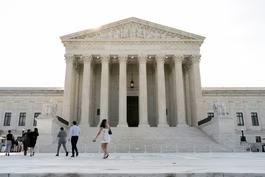
Examining the Supreme Court's birthright citizenship ruling
Video has Closed Captions
Examining the Supreme Court's birthright citizenship, campaign finance rulings (5m 40s)

Hopes of finding earthquake survivors fade in Venezuela
Video has Closed Captions
Rescue efforts continue, but hopes of finding earthquake survivors fade in Venezuela (4m 59s)
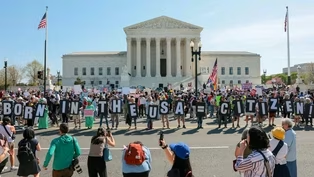
How the birthright citizenship ruling impacts Trump's agenda
Video has Closed Captions
How the birthright citizenship decision impacts Trump's immigration agenda (4m 43s)

News Wrap: Central and eastern U.S. face dangerous heat
Video has Closed Captions
News Wrap: Heat wave brings dangerous temperatures to central and eastern U.S. (7m 15s)
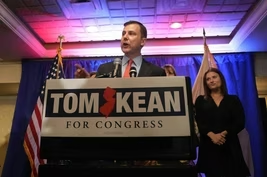
Rep. Kean returns to Congress after mysterious absence
Video has Closed Captions
New Jersey Rep. Tom Kean returns to Congress after mysterious absence (5m 48s)
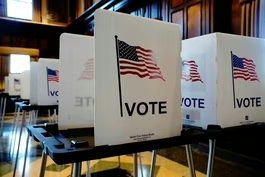
Supreme Court lifts limits on political party spending
Video has Closed Captions
Supreme Court transforms campaign finance rules, lifting limits on party spending (5m 30s)
Who is affected by Supreme Court's ruling on trans athletes
Video has Closed Captions
Who is affected by the Supreme Court's ruling on trans athletes in women's sports (6m 24s)
Providing Support for PBS.org
Learn Moreabout PBS online sponsorship New Episode
- News and Public Affairs

Today's top journalists discuss Washington's current political events and public affairs.

- News and Public Affairs

FRONTLINE is investigative journalism that questions, explains and changes our world.

 New Episode
 New Episode
 New Episode
 New Episode
 New Episode
 New Episode

 New Episode
 New Episode
Support for PBS provided by:
Major corporate funding for the PBS News Hour is provided by BDO, BNSF, Consumer Cellular, American Cruise Lines, and Raymond James. Funding for the PBS NewsHour Weekend is provided by...