Oregon Field Guide
Diving for Geoduck, the World’s Largest Clam
Clip: Season 37 Episode 5 | 9m 50sVideo has Closed Captions
A young couple in the Puget Sound makes a living harvesting the world’s largest clam.
Geoducks, the giant clams of the Pacific Northwest, are considered a seafood delicacy—although they’re mostly exported overseas. We meet a young couple who make a living by harvesting them.
Problems playing video? | Closed Captioning Feedback
Problems playing video? | Closed Captioning Feedback
Oregon Field Guide is a local public television program presented by OPB
Oregon Field Guide
Diving for Geoduck, the World’s Largest Clam
Clip: Season 37 Episode 5 | 9m 50sVideo has Closed Captions
Geoducks, the giant clams of the Pacific Northwest, are considered a seafood delicacy—although they’re mostly exported overseas. We meet a young couple who make a living by harvesting them.
Problems playing video? | Closed Captioning Feedback
How to Watch Oregon Field Guide
Oregon Field Guide is available to stream on pbs.org and the free PBS App, available on iPhone, Apple TV, Android TV, Android smartphones, Amazon Fire TV, Amazon Fire Tablet, Roku, Samsung Smart TV, and Vizio.
Providing Support for PBS.org
Learn Moreabout PBS online sponsorship(boats rattling) - [Mena] We got enough fuel?
- [Ocean] Yep.
- [Mena] I think if you're in the water by 10:15, you should have a really good day.
You're gonna grab this for me?
I'll get the midship.
This is a typical Puget Sound day, you know, typical Washington day, gray and rainy.
- [Ocean] Most of our work days look like this.
- [Mena] Yeah, and you can see we're in, like, fowlies, we're in our, like, bibs, and our gloves, and our hoodies, face masks, and stuff, and, like, it's still bitter cold.
(engine roaring) (water swishing) - [Ocean] This place is kind of the mecca for farmed shellfish, especially geoduck, kinda in the heart of it.
- [Mena] Not a lot of people know about geoducks, even, like, where we live.
- Geoduck is a clam native to the Puget Sound.
- Yep.
- I work on farms, harvesting them.
- [Mena] We go all around the Puget Sound and we harvest some farms, in Totten Inlet, Hammersley Inlet, are some of the places we've harvested geoduck.
A lot of wild ones grow, but they're also farmed, too.
- People are usually very fascinated just by the sound of the job, even though it's not very glamorous at all.
Yeah, it's never just, like, "I'm a geoduck diver."
it's, like, "Do you know what geoduck are, do you...?
It's always, like, a, do they even understand - what they're about to hear?
(chain rattling) - [Ocean] We're obviously a small operation.
- [Mena] Honestly, we're a miniature - [Ocean] We're teeny, tiny.
- [Mena] operation in the world of shellfish.
- [Ocean] We're goofy, too, in our, like, old boat.
- [Mena] That's how we, like, it.
- [Ocean] And we're kinda crusty, - but we try to do a good job.
- [Mean] Exactly.
Okay, I'm putting the dive flag up.
I think we're, like, kinda unique, too, in the geoducking world because we're, like, a couple who does it, and we have been together for, like, 10 years now, we've been together since high school, so it's pretty awesome to be able to, you know, work together, also.
(Ocean breathing) - [Ocean] Com check?
- [Mena] Com check.
- [Ocean] Loud and clear.
- [Mean] Ditto.
- I kinda have to constantly see where he's at, 'cause the patch is actually pretty small.
You can see the buoys.
There's one yellow buoy right there, one right there, and it's, like, 200 feet at most, so it's easy to kinda get off of it.
After we get all set up and Ocean gets in the water, we bring up the geoduck bags, probably once every hour or so, so I have a lot of in between time, and yeah, I basically listen to Ocean breathe for, like, four hours straight.
(engine rumbling) (Ocean breathing) All right, Ocie, what are you doing down there?
- [Ocean] So right now, I'm just moving along the patch and trying to find geoduck shells, which is basically just a dimple in the sand that's showing me where the geoduck is.
(water gurgling) So I have pressurized salt water coming out of what I call a stinger.
It's kinda like a big water gun.
Basically, once I see the shell, I'm grabbing the tip of the geoduck, making sure not to tug on it.
They dig very deep very fast.
- [Mena] It's the world's largest bivalve.
- [Ocean] They're goofy.
- [Mean] Yeah, (chuckles) they are.
- They're funny.
- It's like nature's joke.
- They really are.
- [Ocean] I still get a chuckle out of 'em all the time, - [Mean] Yeah.
- [Ocean] you know, even digging hundreds of them a day.
- [Mena] They're just little unique beings.
The word goeduck comes from a local indigenous language called the Lushootseed language, and it means dig deep, the word geoduck means dig deep, which is, like, pretty true to geoducks.
They have like a little digger fin on the bottom, and they dig really fast.
- [Ocean] It's really interesting how long they can live.
It's, like, 150 years or something.
I was actually kinda like afraid of the water, as a kid, not being on the water, but, like, swimming in the water.
It was uncomfortable and scary.
It was definitely something I never thought I was gonna do, and after months and months of being terrible at it, and being freaked out, and just kind of fumbling around down there, I started to grow to kinda love it.
You get to spend your day with crabs and fish, and it's kinda hanging out in your own cloud down there, and... It's always labor intensive, and it's also kind of intense mentally, sometimes, because you feel the pressure of, you know, you have to get a certain amount of pounds to make it worth it for everybody.
Each goeduck is worth, you know, for me it's, like, a buck fifty or something.
You know, you're down there wearing 70 pounds of weight, hauling around 200 pounds of goeduck.
You know, you're huffing and puffing and... - [Mena] You've been in for 45 minutes on this bag.
- [Ocean] Okay, copy that.
- [Mena] Davit's down, whenever.
- [Ocean] You know, fill up a bag, and send up a bag, feels pretty good.
- [Mena] Okay, the bag's coming up.
(engine rumbling) And they kinda crack, about like an egg, so you have to be really careful, 'cause their shells are really fragile.
The market for them is mostly overseas, so a huge percentage of our goeduck goes to China, where it is definitely a delicacy, it's much more expensive over there, but there isn't, like, as much of a market for them in our area.
You still can buy them, - Yeah.
- and they're still expensive, like they're still, like, $25 a pound where we are, but that's much different to, like, in China where they're going for, like, hundreds of dollars a pound, They're actually a totally, like, a wonderful little thing to eat.
- Well, it's funny, if you, like, take a goeduck - They're really nice.
- and you're, like, "We're gonna eat this," people will be, like, - "Oh, no."
- "No, we're not."
but, like, if you - Even me - cut it, tenderize it, throw it in some breadcrumbs, and fry it, and then give it to 'em, they're, like, fine with it, like, a lot of things.
- Yeah.
- You know, it's really, I think- - Like, you're not just cooking the geoduck and just holding it and eating the siphon.
- [Mena] They actually have a really delicate meat.
They don't have, like, this crazy flavor or anything.
They're really mild, just sort of like your, just, like, a clam, you know ... It's really reminiscent to a razor clam.
Yeah, they're great, you just take off the outer sheath, and you can just, you know, pound them into some fritters, or you can chop 'em up really fine into some ceviche, into chowder, like, just, like, you would any other clam.
(crunching) - Mm, So good!
- So good!
- Getting out of the water after a long dive, like, you're hungry and you're tired, and when you do that every day for hours, wearing all that weight, pulling these geoduck out, taking these 200-pound bags to the brailer, and just getting right back at it, it's a lot of work, and you are tired at the end of the day, and you do know that you can't do it your whole life.
You dig, and you get out of the water, and you look at all the crates filled with geoduck, and you feel pretty good.
- Good.
- [Ocean] Something about being on the water just, there's a lot of freedom associated with it.
This is the only job I've ever had that I can say I love.
It doesn't keep you longing for some other job or some other lifestyle.
You know, you're doing what you like to do, where you like to do it.
(no audio)
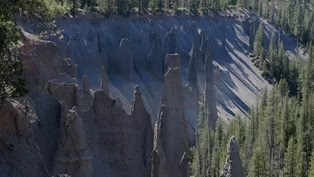
The Lost Pinnacles of Crater Lake
Video has Closed Captions
Clip: S37 Ep5 | 4m 45s | The story of how one of Crater Lake’s most famous attractions fell into obscurity. (4m 45s)
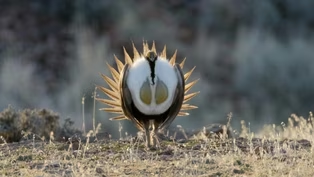
Video has Closed Captions
Clip: S37 Ep5 | 12m 29s | Lithium mining threatens a unique collaboration that’s protected sage grouse for a decade. (12m 29s)
Providing Support for PBS.org
Learn Moreabout PBS online sponsorship













Support for PBS provided by:
Oregon Field Guide is a local public television program presented by OPB