
Why Christmas carols endure as popular music changes
Clip: 12/24/2025 | 7m 27sVideo has Closed Captions
Why Christmas carols endure as popular music changes
From “Silent Night” to “Jingle Bells,” Christmas carols are some of the most familiar songs of the season, and some of the oldest. Stephanie Sy explores why most popular music changes with time, but many of these old tunes have endured.
Problems playing video? | Closed Captioning Feedback
Problems playing video? | Closed Captioning Feedback
Major corporate funding for the PBS News Hour is provided by BDO, BNSF, Consumer Cellular, American Cruise Lines, and Raymond James. Funding for the PBS NewsHour Weekend is provided by...
Why Christmas carols endure as popular music changes
Clip: 12/24/2025 | 7m 27sVideo has Closed Captions
From “Silent Night” to “Jingle Bells,” Christmas carols are some of the most familiar songs of the season, and some of the oldest. Stephanie Sy explores why most popular music changes with time, but many of these old tunes have endured.
Problems playing video? | Closed Captioning Feedback
How to Watch PBS News Hour
PBS News Hour is available to stream on pbs.org and the free PBS App, available on iPhone, Apple TV, Android TV, Android smartphones, Amazon Fire TV, Amazon Fire Tablet, Roku, Samsung Smart TV, and Vizio.
Providing Support for PBS.org
Learn Moreabout PBS online sponsorshipWILLIAM BRANGHAM: From "Silent Night" to# "Jingle Bells," Christmas carols are some## of the most familiar and beloved songs# of the season, and some of the oldest.
Stephanie Sy explores why, even as# popular music changes with the times,## these classics have endured.
STEPHANIE SY: To help us dig into why# Christmas carols have stood the test## of time, I'm joined by Ariana Wyatt,# a professor of voice at Virginia Tech.
Ariana, it's great to have you on the "News Hour."
There are very few things that# haven't changed over the years,## and Christmas carols are one of# them.
In fact, as I was reading,## I understand that some of them date back 2,000# years to the birth of Christ.
Is that right?
ARIANA WYATT, Professor of Voice, Virginia# Tech: It's really remarkable, in fact,## that our first Christmas carol is# really proclaimed in the Gospel,## the "Angels Hymn," or "Gloria in Excelsis# Deo," which is a carol that we sing today## in many different versions and# have over the last 2,000 years.
STEPHANIE SY: I read that that's because# angels were viewed as biblically sort## of singing, that that was a biblical# interpretation of what was happening.
ARIANA WYATT: Yes, that's correct.# Scholars interpret that saying as singing.
And there's a lot of other references# to singing and praising with music,## with song in the Gospel.
So it makes sense# that the angels would have been singing that.
STEPHANIE SY: My favorite Christmas carol is# "O Holy Night."
And there are other carols## that start with this expression, O, right?
O,# come let us adore him.
Talk about the O carols.
ARIANA WYATT: Yes, it's really a fun thing.
So, in the eighth century, they made in the# liturgy a series of antiphons that were in## preparation for the birth of Christ.
So# they were during the period of Advent.## And there were seven specific# ones that led up to December 24.
So the last would be performed on December 23.# And they all started with O, O, and then a name## for God.
So, you had seven of them.
And the last# was "O, Emmanuel," or "O Come, O Come, Emmanuel.
"## And it's really interesting because, if you# reverse the order of the Latin of all of those O,## name for Christ, all seven, it spells ero cras,# E-R-O C-R-A-S, which means "I will come tomorrow."
STEPHANIE SY: Now, speaking of# the Latin, in the Middle Ages,## not a lot of people were speaking# Latin.
How did it become accessible## when Latin itself was not particularly# well-known at the time of these carols?
ARIANA WYATT: So it wasn't until the 12th century# when Saint Francis of Assisi in Italy started to## introduce the vernacular into the Christmas# story.
And so he would take these Christmas## hymns and put the verses in the vernacular,# which would have been Italian where he was.
And then the choruses were -- remained in# Latin.
And that allowed people to start## to connect with the story.
So, previous# to this, these hymns were not popular.## They didn't connect with them.
They# didn't understand what the story was.
STEPHANIE SY: Do we know anything about# the melodies and how they have evolved?
ARIANA WYATT: We assume that some of these# melodies date back to celebrations about## the winter solstice, which predate# Christianity.
And so they would take## these folk tunes and they would put on new# words that were around the Christmas story.
And they are gradually put into the repertory# and passed down through oral tradition,## both by just singing to your own children,# but also by groups of traveling musicians## who would go from town to town and# kind of sing these various songs.
STEPHANIE SY: That's extraordinary.
Speaking of speaking to children,# I used t.. my babies as a lullaby.
Is "Silent# Night" one that dates back pretty far?
ARIANA WYATT: It's actually# one of the more recent ones.## Recent is a subjective term when we're# talking about 2,000 years of history,## of course, but it dates to 1818,# and it was composed in Austria.
Then it was brought to the United States# in 1839 and performed for the first time## in New York City at Trinity Cathedral.
And from# there, it kind of took on a world of its own.## There's a great story of the Christmas truce of# 1914 during World War I, where German and American## troops sang that hymn together from across# the trenches in their respective languages,## because it was one of and remains# one of our shared Christmas carols.
STEPHANIE SY: World War II also gave us some# really emotionally powerful Christmas songs.## What was happening in America at that time# that led to songs like "White Christmas"?
ARIANA WYATT: Yes, there's two large things.
First, we have the invention of recorded sound.
FRANKLIN DELANO ROOSEVELT, Former President of the# United States: A date which will live in infamy.
ARIANA WYATT: That was a huge change to music# and how music is transferred and shared across## continents, really.
And so we have for the# first time the ability to share music out## over the radio, share music that can# be purchased and listened to at home,## which is really remarkable and was --# really changed everything at the time.
But, also, we have two major World Wars that# happened in the 20th century.
And as a result## of that, after World War II, we have a real# economic boom in the United States.
And so we## see a new genre of Christmas music emerge# that is really a contemporary, commercial## Christmas music.
And it has legs because we# can record it and then we can broadcast it.
The first one that we really# look to is "White Christmas,"## which was broadcast for the first time# on the radio on Christmas Day in 1941,## which was just 18 days after Pearl Harbor.
And,# of course, that song is built in nostalgia,## is built in hope for Christmases future,# in nostalgia for Christmases past.
And, of course, the nation was reeling, as was# the world at the time, in the middle of a of a## World War.
And it really spoke to people, which# is why it continues to speak to people today.
STEPHANIE SY: That is Ariana# Wyatt with Virginia Tech.
Ariana, thank you so much and happy holidays.
ARIANA WYATT: Happy holidays.
Go hear some music.
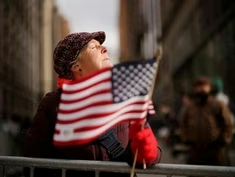
David Baldacci and wife work to counter toxic discourse
Video has Closed Captions
Clip: 12/24/2025 | 8m 23s | How author David Baldacci and his wife are working to counter toxic political discourse (8m 23s)

'Joy to the World' performed by U.S. armed forces musicians
Video has Closed Captions
Clip: 12/24/2025 | 3m 32s | 'Joy to the World' performed by U.S. armed forces musicians (3m 32s)

Local communities may hold the answers to national divisions
Video has Closed Captions
Clip: 12/24/2025 | 10m 15s | Why local communities may hold the answers to national political divisions (10m 15s)

News Wrap: DOJ says more Epstein documents discovered
Video has Closed Captions
Clip: 12/24/2025 | 4m 33s | News Wrap: DOJ says over a million more Epstein documents discovered (4m 33s)

Palestinians mark Christmas in Bethlehem amid conflict
Video has Closed Captions
Clip: 12/24/2025 | 6m 42s | Palestinians mark Christmas in Bethlehem while navigating life during conflict (6m 42s)

Zelenskyy proposal for Russian-occupied areas of Ukraine
Video has Closed Captions
Clip: 12/24/2025 | 4m 36s | Zelenskyy proposes compromise for Russian-occupied areas of Ukraine (4m 36s)
Providing Support for PBS.org
Learn Moreabout PBS online sponsorship
- News and Public Affairs

FRONTLINE is investigative journalism that questions, explains and changes our world.

- News and Public Affairs

Amanpour and Company features conversations with leaders and decision makers.










Support for PBS provided by:
Major corporate funding for the PBS News Hour is provided by BDO, BNSF, Consumer Cellular, American Cruise Lines, and Raymond James. Funding for the PBS NewsHour Weekend is provided by...