Oregon Art Beat
Sisters High School guitar luthier program
Clip: Season 27 Episode 4 | 12m 5sVideo has Closed Captions
Sisters high school luthiers in central Oregon build custom acoustic guitars from scratch.
Sisters, Oregon has one of the only high school guitar luthier programs in the country. Every year, around 30 junior and senior students attempt to build a custom acoustic guitar from scratch, with support from their school, Sisters Folk Festival Presents, and world-renowned Breedlove Guitars.
Problems playing video? | Closed Captioning Feedback
Problems playing video? | Closed Captioning Feedback
Oregon Art Beat is a local public television program presented by OPB
Oregon Art Beat
Sisters High School guitar luthier program
Clip: Season 27 Episode 4 | 12m 5sVideo has Closed Captions
Sisters, Oregon has one of the only high school guitar luthier programs in the country. Every year, around 30 junior and senior students attempt to build a custom acoustic guitar from scratch, with support from their school, Sisters Folk Festival Presents, and world-renowned Breedlove Guitars.
Problems playing video? | Closed Captioning Feedback
How to Watch Oregon Art Beat
Oregon Art Beat is available to stream on pbs.org and the free PBS App, available on iPhone, Apple TV, Android TV, Android smartphones, Amazon Fire TV, Amazon Fire Tablet, Roku, Samsung Smart TV, and Vizio.
Providing Support for PBS.org
Learn Moreabout PBS online sponsorship(music) - The whole point of building a guitar isn't that they walk out of here with a guitar.
For me, it's that they leave with experiences and with the skills to fail and try again.
- [Student] I need some help with a little bit of tools 'cause I don't know how to use those ones.
- Okay, okay.
Okay, gather round, come on over!
Guitar builders!
Who has all their back braces and their back prepared and ready to glue up?
Were you here yesterday to see my presentation on back bracing?
Okay, so remember that you need to mark the middle of the brace.
You need to trim off the ends.
They need to be perfectly sanded.
The story of how our guitar building program came to be started, I think around 2005, Tony Cosby, the previous teacher here, was looking for a way to sort of bring the woods program here up a notch and was aware of Breedlove Guitar Company in Bend.
So, he got with Jayson Bowerman, who was one of the earliest craftspeople at Breedlove.
They brought a lot of the same processes that were there at Breedlove here and set up the shop here to build guitars.
(music) (sander whirring) - It's such a great program, and again, we just wanted to do anything we could to make that program successful because we don't wanna see it go away.
We'd love to see more schools involved in something like that.
(string zipping) (music) - Guitar building is kind of like the pinnacle of woodworking.
So, yeah, a lot of attention to detail.
And you don't wanna mess up (laughing).
(tools whirring) (students chattering) - All righty, what's happening up in this region on your guitar?
- Neck?
- Neck?
- What's inside the guitar right here?
- [Student] The block.
- There's a block there, right, our head block, and then we got another block here, don't we?
It's probably pretty important that we know where those blocks are so we don't put this all the way up underneath where we gotta glue that block, eh?
So, I, yeah, I'm Canadian.
(students laughing) Eh?
- I just confirmed.
- But actually.
Okay, so remember these are going in nice and tight, okay?
Yeah, the timeline and the time constraints are a big piece of what I deal with as the instructor here.
Basically they get two terms outta three, so, about 60 hours a term.
So, 120 hours, unless they put in extra time.
If you ask most guitar builders, they would say that they're the best craftspeople, that it is the pinnacle of woodworking.
So, trying to get 30 a year done is a tall order and we're getting better and better at it.
- Yeah, it's really hard.
Everything has to be so perfect to the point like I had to redo my back.
I messed that up, made it too small.
And then I've had to redo my rosette a couple times.
It's difficult, it's a long process, but gotta be patient with it, yeah.
- So here in front of me is a guitar.
This is an acoustic guitar, so it's not gonna have electronics in it or anything like that.
It generally starts with a rim that you bend the sides.
We have some benders over here that we use.
The curfing goes in here, which basically gives us a ledge to glue our top and back to.
- I felt like I was years away from doing this curfing, but now, you know, finishing it, it feels great.
- Nice, good work.
Yeah, see how much further down these come and they like really press at the bottom of the curfing?
- Yeah.
- And then our tops are generally made out of toned woods like spruce or cedar.
- So I have an Adirondack spruce for my top.
- The tops and the backs are braced with a vertical-grained spruce.
So everything is planned out for strength and for durability and for longevity.
Done yet, Grace?
- All right.
I'm working on it.
- Doing so good.
- I don't like brace land.
- No, I know.
- I was telling them about brace land.
- Brace land, brace land (singing).
- It's the worst land in the world.
- In Sisters, Oregon.
Your guitar's gonna sound better than anybody's 'cause you took so long on your braces.
- It better.
If it doesn't sound like the most angelic guitar on the planet, I'm gonna be mad at you specifically.
- Okay, those are great.
Why don't you go and trim those and put those on.
You did good.
- Wait, I need to make all the little side ones now.
There's so many braces.
- We prepare all these parts.
They take their time getting 'em right and then they all get, then they get glued and assembled together into a body.
So, just like everywhere else, we're just gonna use, you know, like, yay much glue, okay?
So go all the way around and then we're gonna dab that glue down.
We're not going to spread it into these grooves.
We're gonna dab like so.
Nice.
Okay, grab that top.
You're gonna put that in here, I'll take this half.
Go ahead and line up that back line and then we'll pop it down into your pockets.
Make sure it's in those pockets.
You happy?
- Yep.
- Okay.
Go ahead and grab the donut next.
Donut goes right over that.
This just helps give us, its focuses the pressure on the rim.
And that one's heavy.
Lift with your neck, not with your back.
There you go, careful.
Awesome.
Okay.
Okay, go ahead and crank this down.
And whenever you get to the metal, slow down.
It's not gonna take much here, all right?
- Little bit of a gap on this side.
- That's it.
Oh yeah, booyah.
Nice work.
We can do all kinds of trimming and work on the body.
And then the neck also has to be built, the fingerboard, the frets.
- Right now I'm working on the fretboard inlay and so this is gonna be the design basically.
Bunch of different triangles, different shades of wood.
Yeah, hopefully I take this as a career.
I'm doing an internship at a banjo place in Sisters right now.
It's really one of my biggest passions, yeah.
- Sisters, Oregon is an amazing place.
I love that the Three Sisters end up on guitars more often than anything.
- I'm gonna do like mountain inlays on my fretboard.
I love to kind of be out with nature and to me, like no matter where I am when I graduate or when I go, it'll always kind of be a piece of home 'cause like those mountains, those Three Sisters are like a staple to us.
- Yeah, I grew up in Sisters from when I was I think three.
We're on the highway to Redmond, so I'm more out in the rural area, the farming communities.
- [Jason] Okay, electric guitar boys, how we doing?
- [Student] Heard a lot of crying.
- You're, not to cry?
- Yeah.
- Not today.
- Look at this.
- Why is it doing this?
- It's not your turn to cry.
- This is my plate.
And this, I'm gonna dip that in 0.1 inches 'cause the plates are 0.1 inches thick.
- Okay.
- Is that too thin?
Should I do it thicker?
- Well, lemme see this.
- I've been playing music since I was like seven.
It's a lot of fun getting to play a guitar that I made, and I get a lot of questions about like where I got the guitar, and it's fun like being able to tell people that I made it myself.
- I might have offset this geometry line, Brennan, and used that as my geometry for the pocket.
- This is the one class in the day that I like actually enjoy.
Like most of my other classes, I have a bunch of English and social studies, and it's fun to be able to come here and sort of relax while screaming at a computer.
For me, I was homeschooled for most of my life.
And then I heard about, actually I heard about the program through Chinchen who was my eighth grade wrestling coach, and he was talking about the woods program.
I'm like, that sounds really cool.
I wanted to go to the high school.
So I decided I was gonna come here and do the woods program.
- The experience of being in this room with my students and watching them grow as little humans into little adults and being a part of that part of their life and being able to be an example and, is really special.
- He's like one of the teachers that I like have a, like the closest relationship with.
He's the teacher that I could just show up in his classroom and he'd be like, "Oh, hey, you're here."
- I'm, I don't know how to describe it, but it's like such a surreal feeling that nobody else really is doing this.
And here in a small town in the like middle of nowhere Oregon is doing this program, and it's just really, really, really special to be able to do it.
- Yeah, they are building a guitar in here, and that's amazing and hard to do.
But it's harder to make a mistake and be gentle with yourself and then pick yourself up and find a solution.
That has to be our way of approaching the world.
Because if it isn't, we're going to get bogged down and we're gonna get stuck and we're gonna feel hopeless.
And if we don't have agency, then we can't make positive changes in our own lives or in others.
So remember, a little amount of glue.
Not too much.
Okay, I overdid it.
Just get rid of it.
I just try to make sure that I have a space that everyone feels welcome in.
The first speech I give to every one of my classes on the first day is, you're welcome here, you are safe here.
Be a human and we'll get through it.
- [Student] Can you help me find the 1/16ths?
- First thing tomorrow, 'cause it's cleanup time.
- Okay.
- Okay.
All right, cleanup time!
Clean up!
(music) All right, have a good day.
Good job.
- Thank you.
- See you tomorrow.
Thanks, Hailey.
Devin, bye.
Good work.
See you, Dakota, good job.
Jackson, have a good day.
- You too.
- Thanks for letting me help.
- Thank you for your help.
It's awesome to have you in here.
The first time that they put a string on, and before they're allowed to pluck that first string, I gather everybody around and we celebrate that baby being born.
Lots of good memories there, yeah.
(music) I love what I do, a lot.
I feel really lucky.
Really lucky.
(music) Where's my coffee?
A plus!
Video has Closed Captions
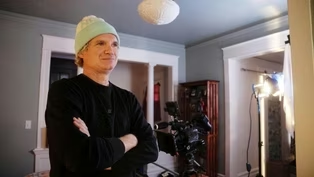
Clip: S27 Ep4 | 4m 25s | James Westby embraces DIY ethos to make micro-budget movies in the Pacific Northwest. (4m 25s)

Portland’s historic Hollywood Theatre celebrates 100 years of movie magic.
Video has Closed Captions
Clip: S27 Ep4 | 9m 28s | Hollywood Theatre is an icon of Portland cinema and has been witness to the entire history of film. (9m 28s)
Providing Support for PBS.org
Learn Moreabout PBS online sponsorship














Support for PBS provided by:
Oregon Art Beat is a local public television program presented by OPB