Oregon Art Beat
Sisters High School guitar luthier program, filmmaker James Westby, Hollywood Theatre
Season 27 Episode 4 | 28mVideo has Closed Captions
Sisters high school guitar luthier program, filmmaker James Westby, Oregon's Hollywood Theatre
Sisters high school guitar luthier program, in Sisters Oregon, is one of only two such programs in the country. Portland filmmaker James Westby embraces a DIY ethos, making micro-budget films in the Pacific Northwest. The Hollywood Theatre is an icon of Portland cinema, and has been witness to the entire history of film.
Problems playing video? | Closed Captioning Feedback
Problems playing video? | Closed Captioning Feedback
Oregon Art Beat is a local public television program presented by OPB
Oregon Art Beat
Sisters High School guitar luthier program, filmmaker James Westby, Hollywood Theatre
Season 27 Episode 4 | 28mVideo has Closed Captions
Sisters high school guitar luthier program, in Sisters Oregon, is one of only two such programs in the country. Portland filmmaker James Westby embraces a DIY ethos, making micro-budget films in the Pacific Northwest. The Hollywood Theatre is an icon of Portland cinema, and has been witness to the entire history of film.
Problems playing video? | Closed Captioning Feedback
How to Watch Oregon Art Beat
Oregon Art Beat is available to stream on pbs.org and the free PBS App, available on iPhone, Apple TV, Android TV, Android smartphones, Amazon Fire TV, Amazon Fire Tablet, Roku, Samsung Smart TV, and Vizio.
Providing Support for PBS.org
Learn Moreabout PBS online sponsorshipSupport for Oregon Art Beat is provided by Jordan Schnitzer and the Harold & Arlene Schnitzer Care Foundation Endowed Fund for Excellence... and OPB members and viewers like you.
Funding for arts and culture coverage is provided by... [ ♪♪♪ ] [ ♪♪♪ ] MAN: The whole point of building a guitar isn't that they walk out of here with a guitar.
For me, it's that they leave with experiences and with the skills to... to fail and try again.
BOY: I need help with a little bit of tools because I don't know how to use those ones.
MAN: Okay.
Okay, gather round.
Come on over!
Guitar builders!
Uh, who has all their back braces and their backs prepared and ready to glue up?
Were you here yesterday to see my presentation on back bracing?
Okay, so remember that you need to mark the middle of the brace, you need to trim off the ends, they need to be perfectly sanded.
The story of how our guitar-building program came to be started, I think, around 2005.
Tony Cosby, the previous teacher here, was looking for a way to sort of bring the woods program here up a notch and was aware of Breedlove Guitar Company in Bend, so he got with Jayson Bowerman, who was one of the earliest craftspeople at Breedlove.
They brought a lot of the same processes that were there at Breedlove here and set up a shop here to build guitars.
[ sander whirring ] [ ♪♪♪ ] WOMAN: It's such a great program, and, again, we just wanted to do anything we could to make that program successful, because we don't want to see it go away.
We'd love to see more schools involved in something like that.
Guitar building is kind of like the, uh... the pinnacle of woodworking.
So, yeah, a lot of attention to detail and you don't want to mess up.
[ chuckles ] [ playing soft folk tune ] [ indistinct voices chattering in background ] Artie, what's happening up in this region on your guitar?
What's inside your guitar right here?
STUDENT: The block.
There's a block there, right, our head block.
And then we got another block here, don't we?
It's probably pretty important that we know where those blocks are so we don't put this all the way up underneath where we've got to glue that block, eh?
BOY: Yeah, eh?
So... Uh, yeah, I'm Canadian.
[ students laugh ] Eh?
But actually... Aye, skipper.
Okay, so remember, these are going in nice and tight, okay?
Yeah, the timeline and the time constraints are a big piece of what I deal with as the instructor here.
Basically they get two terms out of three, so about 60 hours a term, so 120 hours unless they put in extra time.
If you asked most guitar builders, they would say that they're the best craftspeople, that it is the pinnacle of woodworking.
So trying to get 30 a year done is... is a tall order, and we're... we're getting better and better at it.
[ chuckles ] Yeah, it's really hard.
Everything has to be so perfect to the point, like, I had to redo my back, I messed that up, made it too small.
And then I've had to redo my rosette a couple times.
It's difficult.
It's a long process, but you've got to be patient with it, yeah.
[ saw whirring ] [ ♪♪♪ ] So here in front of me is a guitar.
This is an acoustic guitar, so it's not going to have electronics in it or anything like that.
It generally starts with... with a rim that you bend the sides.
We have some benders over here that we use.
The kerfing goes in here, which basically gives us a ledge to glue our top and back to.
NORAH: I felt like I was years away from doing this kerfing, but now, you know, finishing it, it feels great.
Nice.
Good work.
Yeah, see how much further down these come, and they, like, really press at the bottom of the kerfing?
Yeah.
And then our tops are generally made out of tone woods like spruce or cedar.
So I have an Adirondack spruce for my top.
The tops and the backs are braced with a vertical-grain spruce, so everything is planned out for strength and for durability and for longevity.
Done yet, Grace?
All right.
[ laughs ] I'm working on it!
JASON: You're doing so good.
GRACE: I don't like Braceland.
I was telling them about Braceland.
♪ Braceland, Braceland ♪ It's the worst land in the world.
♪ In Sisters, Oregon ♪ Your guitar is going to sound better than anybody's because you took so long on your braces.
[ chuckles ] It better!
If it doesn't sound like the most angelic guitar on the planet, I'm gonna-- I'm gonna be mad at you specifically.
[ both laugh ] Okay, those are great.
Yes!
Why don't you go and trim those and put those on?
Yes!
You did good.
Wait, I need to make all the little side ones now.
I had this feeling.
There's so many braces!
JASON: We prepare all these parts.
They take their time getting them right, and then they all get, um-- Then they get glued and assembled together into a... into a body.
So just-- Just like everywhere else, we're just going to use, you know, like yay much glue, okay?
So go all the way around, and then we're gonna dab that glue down.
We're not going to spread it into these grooves.
We're going to dab like so.
Nice.
Okay, grab that top... gonna put that in here.
I'll take this half.
Go ahead and line up that back line, and then we'll pop it down into your pockets.
Make sure it's in those pockets.
You happy?
Yep.
Okay.
Uh, go ahead and grab the donut next.
Donut goes right over that.
This just helps give us-- It focuses the pressure on the rim.
And that one's heavy.
Lift with your neck, not with your back.
There you go, careful.
Awesome.
Okay.
Okay, go ahead and crank this down, and whenever you get to the metal, slow down.
It's not going to take much here, all right?
Little bit of a gap on this side.
Eh, that's it.
Oh, yeah.
Booyah!
Nice work.
We can do all kinds of trimming and work on the body, and then the neck also has to be built, the fingerboard, the frets.
BOY: Right now I'm working on the fretboard inlay.
And so, uh, this is going to be the design, basically.
A bunch of different triangles, different shades of wood.
Uh, yeah, hopefully I take this as a career.
I'm doing an internship at a banjo place in Sisters right now.
It's really one of my biggest passions, yeah.
[ ♪♪♪ ] JASON: Sisters, Oregon, is an amazing place.
I love that the Three Sisters end up on guitars more often than anything.
NORAH: I'm going to do, like, mountain inlays on my fretboard.
I love to kind of be out with nature.
And to me, no matter where I am when I graduate or when I go, it'll always kind of be a piece of home, because, like, those mountains, those Three Sisters are like a staple to us.
BOY: Yeah, I grew up in Sisters from when I was, I think, 3.
We're out on the highway to Redmond, so I'm more out in the rural area, out in the farming communities.
Okay, electric guitar boys, how we doing?
I'm about to cry.
You're about to cry?
Yeah.
Not today.
Why is it doing this?
It's not your turn to cry.
Uh, this is my plate.
Okay.
I'm going to divot that in .1 inches.
Because the plates are .1 inches thick.
Okay.
Is that too thin?
Should I do it thicker?
Well, let me see this.
I've been playing music since I was like 7.
It's a lot of fun getting to play a guitar that I made, and I get a lot of questions about, like, where I got the guitar, and it's fun, like, being able to tell people that I made it myself.
I might've offset this geometry line, Brennan, and used that as my geometry for the pocket.
This is the one class in the day that I, like, actually enjoy.
Like, most of my other classes, I have a bunch of English and Social Studies, and it's fun to be able to come here and sort of relax while screaming at a computer.
For me, I was homeschooled for most of my life, and then I heard about-- Actually, I heard about the program through Chinchen, who was my eighth-grade wrestling coach, and he was talking about the woods program, and I'm like, "That sounds really cool.
I want to go to the high school."
So I decided I was going to come here and do the woods program.
[ ♪♪♪ ] JASON: The experience of being in this room with my students and... and watching them grow as little humans into little adults and being a part of that part of their life and being able to be an example and, um... is really special.
He's like one of the teachers that I, like, have the closest relationship with.
He's the teacher that I could just show up in his classroom and he'd be like, "Oh, hey, you're here.
I'm-- I don't know how to describe it, but it's like such a surreal feeling that nobody else really is doing this, and here in a small town in the, like, middle of nowhere, Oregon, is doing this program.
And it's just really, really special to be able to do it.
Yeah, they are building a guitar in here.
And, um-- And that's amazing and hard to do.
Um, but it's harder to make a mistake and be gentle with yourself and then pick yourself up and find a solution.
That has to be our way of approaching the world, because if it isn't, we're going to get bogged down and we're going to get stuck and we're going to feel hopeless.
And if we don't have agency, then we can't-- We can't make positive changes in our own lives or in others.
So remember, a little amount of glue, not too much.
Okay, I overdid it.
Just get rid of it.
I just try to make sure that I have a space that everyone feels welcome in.
The first speech I give to every one of my classes on the first day is, "You're welcome here, you are safe here.
Be a human and we'll get through it."
Can you help me find a 1/16th...?
Um, first thing tomorrow, because it's clean-up.
Okay.
Okay.
All right, clean-up time!
Clean up!
[ ♪♪♪ ] All right, have a good day.
Good job.
See you tomorrow.
Thanks, Hailey.
Devin, bye.
Good work.
See you, Dakota.
Good job.
Jackson, have a good day.
You too.
Thank you for your help, it's awesome to have you in here.
Bye.
The first time that they put a string on and before they're allowed to pluck that first string, I gather everybody around and we celebrate that baby being born.
Um... lots of good memories there, yeah.
I love what I do a lot.
I feel really lucky.
Really lucky.
Where's my coffee?!
A-plus!
[ ♪♪♪ ] I was just this annoying kid who-- [ laughs ] Who just, you know, needed to make a film.
[ ♪♪♪ ] I was living in Bellingham.
I was 19-- 18, 19.
And I saw "Drugstore Cowboy," the film by Gus Van Sant.
I moved here because of that movie.
There was something about the look of the film and the city that it was filmed in.
I wasn't planning to go to college, I just wanted to make films.
And I found out, my first trip here, about the Northwest Film Center, and it was great.
I learned how to use the equipment and started making my feature-film debut, called "Subculture."
That film got me out there and I played it at the Clinton Street Theater, and my parents came and they loved it.
[ chuckles ] And then from there, I just kept making films.
[ ♪♪♪ ] Eventually, you know, it became digital and way easier to make on an even lower budget, and I made my movie "Film Geek."
I'm looking for a movie but I can't think of the name.
I think it's got the word "heaven" in the title.
"Far From Heaven"?
"Days of Heaven"?
"Gates of Heaven"?
"Heaven's Gate"?
Um... "Heaven Can Wait", 1943, directed by Ernst Lubitsch?
Ironically, it was made for about $3,000.
And that movie got into Tribeca and played at major festivals.
And I've continued to be a very low-budget filmmaker ever since, and this new picture is no exception.
GIRL: I've always been a sleepwalker.
It took my parents a few years to catch on.
My mom and dad think I don't know they're gonna get divorced.
It was fortuitous in that my friend Chelsea Cain, the novelist... I have published 12 or 13 books.
Seven of them are thrillers.
She and I went to high school together, actually, for a short bit up in Bellingham, Washington.
He sat behind me in Western Civ junior year of high school.
She wrote a script, a horror script, and she wrote it for my daughter.
These are my woods.
[ ♪♪♪ ] This is my dog.
This is where we're staying.
Do you ever get the feeling your parents are trying to kill you?
What?
She's always got this very deadpan expression and is clearly just-- The camera loves her.
She's got a lot of screen presence, that one, and Chelsea saw that.
I came up with this scheme that I would write this movie for his daughter to star in and then he would have to direct it, and he fell for it hook, line, and sinker.
We agreed to do it and put it together with myself and Cleo's mom and Cleo playing this family.
"The Bend" is about this family who goes to their vacation house in central Oregon and their daughter sleepwalks into the woods and then comes back and things get weird.
JAMES: Cleo likes to say ghosty things start to happen, which is true.
It became a family affair, and I guess because we're not actors, one thing that helped really cement us as a believable family is that I am going through several thousands of home movies and mostly, you know, still photographs and, you know, it adds production value to an otherwise very low-budget film.
It takes place, you know, basically in one location, so it was doable.
We were able to get extras who came from Bend and Sisters for a search-party scene.
It was really fun to involve the community.
It'll be, I think, a really fun movie for Oregonians.
When I was younger, I was so obsessed with making films and getting them into big festivals and having them play in theaters.
Okay, let's do it.
Okay.
Everybody quiet, please.
Okay, speed.
And action, Tom.
Having played at Tribeca and a couple other big festivals, it was a blast, but it's exhausting, and I'm older now.
Cute, all right, good.
All right, cool.
I just want to make good stuff and get it out there but not stress about it, you know?
[ laughs ] [ film whirring ] [ music playing over speakers ] Movies are moving history.
It's not just the history of what we've done, but history of what we all go through in our lives.
Hello, Your Grace.
And cinema is the ultimate art form.
Oh, the marquis!
[ ♪♪♪ ] Everybody likes to show a movie that they love to a friend, and being able to do that to 400 people, it's special.
It's not just watching a movie, it's a night out.
I am Dan Halsted, I'm the head film programmer here at the Hollywood Theatre in Portland, Oregon.
At the age of 18, I got a job as a projectionist, and I was excited to find out that there's a job that you just watch movies and handle film, that you don't have to deal with people.
I mean, I thought, "I'm gonna do this for the rest of my life."
The Hollywood opened in 1926.
It was originally, I think, 1,500 seats, but it was originally silent films with an organ and an orchestra and then vaudeville before some of the movies.
And then in the '60s, this was a Cinerama theater.
They used three projectors running at the same time to project a gigantic image.
And then in the '70s, the theater was chopped up into three different auditoriums, and then it became a second-run theater.
So it really followed-- Everything that happened in film history happened in this building.
[ sirens wailing ] In the mid-'90s, there was a building next door that burned down, and the theater was almost burned down at the same time, and it was owned by a chain theater at that time, and I think they finally threw in the towel on the business, and so they sold it to a group that started a nonprofit to save the Hollywood Theatre.
So this is in our main projection booth.
These are our Norelco projectors that run 35mm and 70mm.
These are the greatest film projectors ever made.
Been here since the early '60s.
We've already had to replace our digital projector, but the film projectors are still here.
We put a reel of film at the top, the film goes through the projector.
The intermittent sprocket is pulling the film in at 24 frames per second, giving the illusion of movement.
It's usually 16 to 18 minutes per reel, so-- But, you know, some movies can be ten reels long, so it's a lot of work for the projectionist.
And new problems arise all the time.
It's unbelievable.
Our technical director actually describes it as a very monotonous job with moments of sheer terror.
[ laughs ] [ music playing over speakers ] People have responded very well to 70mm.
It's guaranteed sellout any time we show 70mm.
You know, we have our own print of "2001: A Space Odyssey," which we paid to have a brand-new print made that then we show whenever we want.
This is the film archive.
This is where I store all my 35mm prints and the prints that belong to the Hollywood Theatre as well.
And it's perfect film storage down here.
It stays the same temperature all the time.
This is our 70mm print of "2001: A Space Odyssey."
It's ten reels long.
This is what... So this is what 70mm looks like.
So that's one reel of 70mm.
So that's only about 15 minutes of film, maybe not even that much.
So that's the difference in size.
So this is one reel of 35 versus one reel of 70mm.
Now, 35mm is so great, but 70, especially when something's shot in this format and then projected in it, is just... It's the best quality image you can have.
It's interesting that Portland's such a movie-watching town.
I do think part of it is because it rains all the time.
Outside of that, I don't know.
We just have this weird outsider culture that loves movies.
And not just the classic films, but we can show obscure stuff and we can show just really fun, oddball movies and we can draw a crowd.
Even quite a few of the special guests that I've brought up from L.A., they come here and they're shocked.
They're like, "Well, how do you have so many people showing up here?
How do you have Movie Madness?"
My name is Matt Parnell, and I'm the managing director and head curator for Movie Madness.
We've been here since 1991.
We're one of the biggest videos stores in North America.
I'd like to show you around a little bit.
This is our new release area.
This is where all the brand-new movies that come out, this is the first place you'll find them, is on this shelf here.
Across from that area, we have our community curated shelves.
This is where we have different community members giving us their choice pics.
We come over this way, we walk by our animation section, our comic-book superheroes area, and into the classics.
This is the Best Picture from every year from 1927 all the way up until last year is going to be found right here.
We have over 94,000 movies here at Movie Madness, so you can spend a lot of time perusing the shelves.
As I'm walking through the foreign section, there's this big open display case right here that has a lot of memorabilia in it that all belongs to Mike Clark, the founder of Movie Madness, who founded it in 1991.
He started collecting these costumes in 1994.
My wife actually used to work at Movie Madness in the '90s.
Then in 2016, Mike Clark said that he wanted to sell it.
It was time for him to retire.
He didn't want to liquidate the store, he wanted to sell it, and so my wife actually came up with the idea of why not sell it to the Hollywood and bring it under the Hollywood's nonprofit?
MATT: When the Hollywood took over, we weren't looking at ourselves so much as a retail business anymore but more of like a resource for the community, and we all started to kind of reframe our thinking of ourselves and realizing, like, this is a film archive.
We're not just here to collect money from people so they can rent a movie.
For us, it's really important to think about protecting that archive and making it available to the public to enjoy it.
Thank you.
[ woman speaking indistinctly over PA ] My name is Ted Hurliman.
I'm the director of education and special projects at the Hollywood Theatre, which I think is maybe one of the best jobs in the world.
The airport reached out to us, and it seemed like an amazing opportunity, because we're at the crossroads of I don't know how many travelers going any which way, and they get to sit in there, they get to watch some movies, we get to reach out to local filmmakers and show their things.
WOMAN: We have an open call through the Hollywood Theatre.
We're focused really on artists in the region and what's happening in the Pacific Northwest.
I think a lot of the nation may not know how much is happening here in Portland and in the region, and it's a great way to share that with travelers.
[ ♪♪♪ ] DAN: RZA has a real passion for cinema.
And one of the things he was interested in is I have the only known 35mm print of "The Mystery of Chess Boxing," which is a classic kung fu film.
And then RZA, while he was on tour with the Wu-Tang Clan, he said, "Hey, while I'm in Portland, why don't we do a screening of the film?"
♪ Earn my respect Yours I collect with finesse ♪ ♪ Finesse, finesse... ♪ That, again, is an obscure film, but it sold out in just a manner of minutes.
He is a filmmaker, he is a director, he is an actor, he is one of the greatest hip-hop producers of all time.
Please welcome to the stage the RZA!
[ crowd cheering ] ♪ --collect with finesse Jump, jump, jump it... ♪ Thank you, everybody, thank you.
I mean, that communal experience of watching a movie together is what makes watching a movie in the theater powerful.
There's something about that: the electricity in a crowd, feeling the impact with other people.
So what I hope is people come here, see a film they've never experienced, then they'll go to Movie Madness and find more movies by the same director or from that same genre.
I just want my love of cinema to keep spreading to other people and to keep cinema alive.
♪ Jump, jump, jump, jump it Jump, jump... ♪ [ tuning ] All right.
[ strums chord ] It's always exciting to hear them for the first time.
To learn more about Oregon Art Beat, visit our website... And to see what we're working on now, follow us on Facebook and Instagram.
[ guitar playing tune ] Support for Oregon Art Beat is provided by Jordan Schnitzer and the Harold & Arlene Schnitzer Care Foundation Endowed Fund for Excellence... and OPB members and viewers like you.
Funding for arts and culture coverage is provided by...
Video has Closed Captions
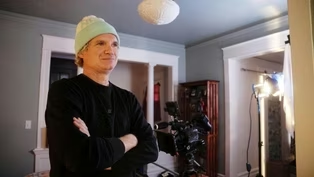
Clip: S27 Ep4 | 4m 25s | James Westby embraces DIY ethos to make micro-budget movies in the Pacific Northwest. (4m 25s)
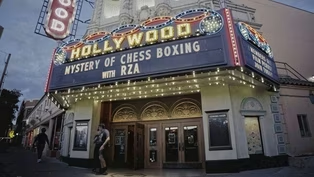
Portland’s historic Hollywood Theatre celebrates 100 years of movie magic.
Video has Closed Captions
Clip: S27 Ep4 | 9m 28s | Hollywood Theatre is an icon of Portland cinema and has been witness to the entire history of film. (9m 28s)
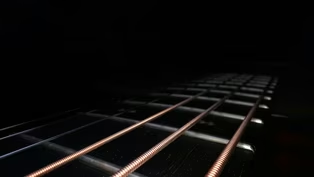
Sisters High School guitar luthier program
Video has Closed Captions
Clip: S27 Ep4 | 12m 5s | Sisters high school luthiers in central Oregon build custom acoustic guitars from scratch. (12m 5s)
Providing Support for PBS.org
Learn Moreabout PBS online sponsorship














Support for PBS provided by:
Oregon Art Beat is a local public television program presented by OPB