
Here and Now
Alder Michael Martens on Replacing Wausau's Lead Water Pipes
Clip: Season 2500 Episode 2513 | 6m 2sVideo has Closed Captions
Michael Martens on Wausau's goal to remove and replace lead services lines before 2029.
City of Wausau Alderperson Michael Martens discusses the city's goal to remove and replace about 3,000 remaining lead services lines before 2029 and its plan to pay private-side costs for the project.
Problems playing video? | Closed Captioning Feedback
Problems playing video? | Closed Captioning Feedback
Here and Now is a local public television program presented by PBS Wisconsin
Here and Now
Alder Michael Martens on Replacing Wausau's Lead Water Pipes
Clip: Season 2500 Episode 2513 | 6m 2sVideo has Closed Captions
City of Wausau Alderperson Michael Martens discusses the city's goal to remove and replace about 3,000 remaining lead services lines before 2029 and its plan to pay private-side costs for the project.
Problems playing video? | Closed Captioning Feedback
Where to Watch Here and Now
Here and Now is available to stream on pbs.org and the PBS app.
Providing Support for PBS.org
Learn Moreabout PBS online sponsorshipAbout 1 in 10 municipal water lines are served by lead pipes in Wisconsin.
Or according to Wisconsin Watch data, more than 145,000 of them lead in drinking water poses serious health risks, especially to children and pregnant women, as no level of lead exposure is considered safe.
While cities and municipalities across Wisconsin are working to remove lead service lines ahead of a 2037 federal deadline, one city in the midst of the work stands out.
The City of Wausau is on track to replace its remaining some 3000 lead lines by the end of 2028.
That's after already replacing about 3500, the City Council Finance Committee just voted to pay 100% of the cost for residents.
Committee chair Alderman Michael Martins joins us.
And thanks very much for being here.
>> Oh, thank you so much.
Thank you for inviting me.
>> So what is the cost, on average, for residents to replace their lead service lines?
>> Well, it depends on, you know, on on the situation what the composition of their soil is.
We've been averaging about, you know, with, with the, with the current process, about $6,700 per lead service line.
>> And so that's a that's a lot of money for any individual homeowner.
Why did the Finance Committee decide to go ahead and cover that cost?
>> Well, when we looked at the numbers and we saw, you know, we started lead service line replacements in 2024, and we've been very aggressive in moving forward with this, with this program.
And since we've just passed the half way point, we felt that we were we could get as many of these lines done as quickly as we could instead of spreading everything out until that 2037 deadline, we would, you know, even though the upfront cost is more, you know, for us for the next two years, we would we could finish the program by 2028, saving potentially up to $37 million.
And, you know, before the, you know, if we were to if we were to slow our roll.
>> So what is the total cost of the project expected to be when you're finished?
>> I think all in in all done.
It's going to be well over $57 million.
It's and and a significant portion of it.
We've been able to, you know, recover through federal and state grants.
Principal forgiveness loans.
What you know, what we've come up with, you know, is, is as the as the program continues, our funding gap, you know, increases from year to year.
And that's where the city ends up paying more on these last these last three years of the of the replacement program.
>> And isn't it also true that some of these government grants and loans could be drying up as well?
>> You know, they're it's it's part of it is they're drying up.
And other part of it is other communities are coming online with their replacement programs.
So it's the pot is, you know, not only dwindling, but there's more people looking for a share of the of the loans of the principal forgiveness.
You know, we've been fortunate by getting an early start.
We've been able to capture a lion's share of that.
>> So going forward into the next couple of years, as, as you aggressively push to remove these lead lines.
Can the city coffers handle that?
>> I that remains to be seen.
I think, you know, for for at least 2027, I think we are we should be able to, you know, to, to manage it.
What the what the funding gap will be in 2028.
You know, we're still going to have to analyze our debt ratios are at a point where, you know, we can it's it's it, you know, our debt ratios are at the point where we can, you know, we can still manage that.
And I think, you know, you know, we do want to reduce our long term debt, but also, you know, keeping our debt levels, you know, in the future at a, at a manageable pace, you know, is, is also part of that.
>> So.
Meanwhile, the full city council is expected to vote on paying the full cost.
Do you expect that to pass?
>> You know, it remains to be seen.
I think there's, you know, some people that are concerned about what our what our municipal debt level is.
But I think in the long term, this whole, you know, this should win out as a as people see the greater benefits of getting the lead out of our water system and getting this program finished up in a timely manner, you know, so that we can move on.
And in the future, you know, be more be more aggressive with other, you know, other debt reduction programs.
I mean, right now, we've got the ability, you know, to get these loans at a quarter of a percent.
So doing it now saves money later.
We're probably on the leader statewide were the leaders, you know, with with Milwaukee and Racine.
We've been I think we've been fortunate that our previous, you know, mirror, mirror administration really worked hard to secure this funding and to get us, you know, get us set up with this public private partnership that it's really saving a lot of money.
And I hope people see that.
>> All right.
Well, Michael Martens Alderperson, City of Wausau, thanks so much.
>> Okay.
Well, thank you so much.
It's a pleasure to be here.
>> Two years ago, we checked in with the mayor
 New
NewHere & Now opening for September 25, 2026
Video has Closed Captions
Clip: S2500 Ep2513 | 1m 4s | The introduction to the September 25, 2026 episode of Here & Now. (1m 4s)
 New
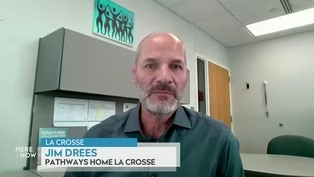
NewJim Drees on a Program to Reduce Homelessness in La Crosse
Video has Closed Captions
Clip: S2500 Ep2513 | 6m 39s | Jim Drees on La Crosse's goal of achieving a "functional zero" homeless population. (6m 39s)
 New
NewThe Red Cliff Band and the Future of the Apostle Islands
Video has Closed Captions
Clip: S2500 Ep2513 | 6m 31s | Tribal leaders question a bill to redesignate the Apostle Islands National Lakeshore. (6m 31s)
 New
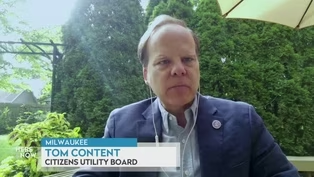
NewTom Content on Global Energy Prices and Winter Heating Costs
Video has Closed Captions
Clip: S2500 Ep2513 | 5m 38s | Tom Content on spikes in costs of heating fuels as utilities move to hike prices. (5m 38s)
 New
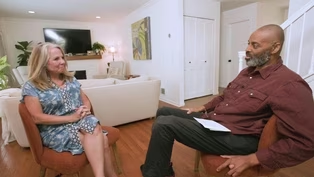
NewIn Focus with Wendi Dwyer: From Disability to Accessibility
Video has Closed Captions
Clip: S2500 Ep2513 | 49m 56s | Wendi Dwyer on work to increase empathy and access for people with disabilities. (49m 56s)
Providing Support for PBS.org
Learn Moreabout PBS online sponsorship New Episode
- News and Public Affairs

Top journalists deliver compelling original analysis of the hour's headlines.
 New Episode
- News and Public Affairs

Today's top journalists discuss Washington's current political events and public affairs.


 New Episode
 New Episode
 New Episode
 Recently Added
 New Episode
 New Episode


 New Episode
Support for PBS provided by:
Here and Now is a local public television program presented by PBS Wisconsin